
Berlin Nights
Some nocturnal ramblings

BERLIN NOVEMBER
Berlin nights, Berlin days … The days are like nights, from late October onwards. It’s rather as if someone had suddenly flipped a switch, and from that point on there was no light by day, no source of warmth, no energy. We’re all here with our winter lamps and our vitamin D.
Though there are still just a few briefly brilliant days. Days of bright sun lighting the domes and façades; of glorious autumn colours along the canal; of the Fernsehturm sticking up in cold majesty above it all ...
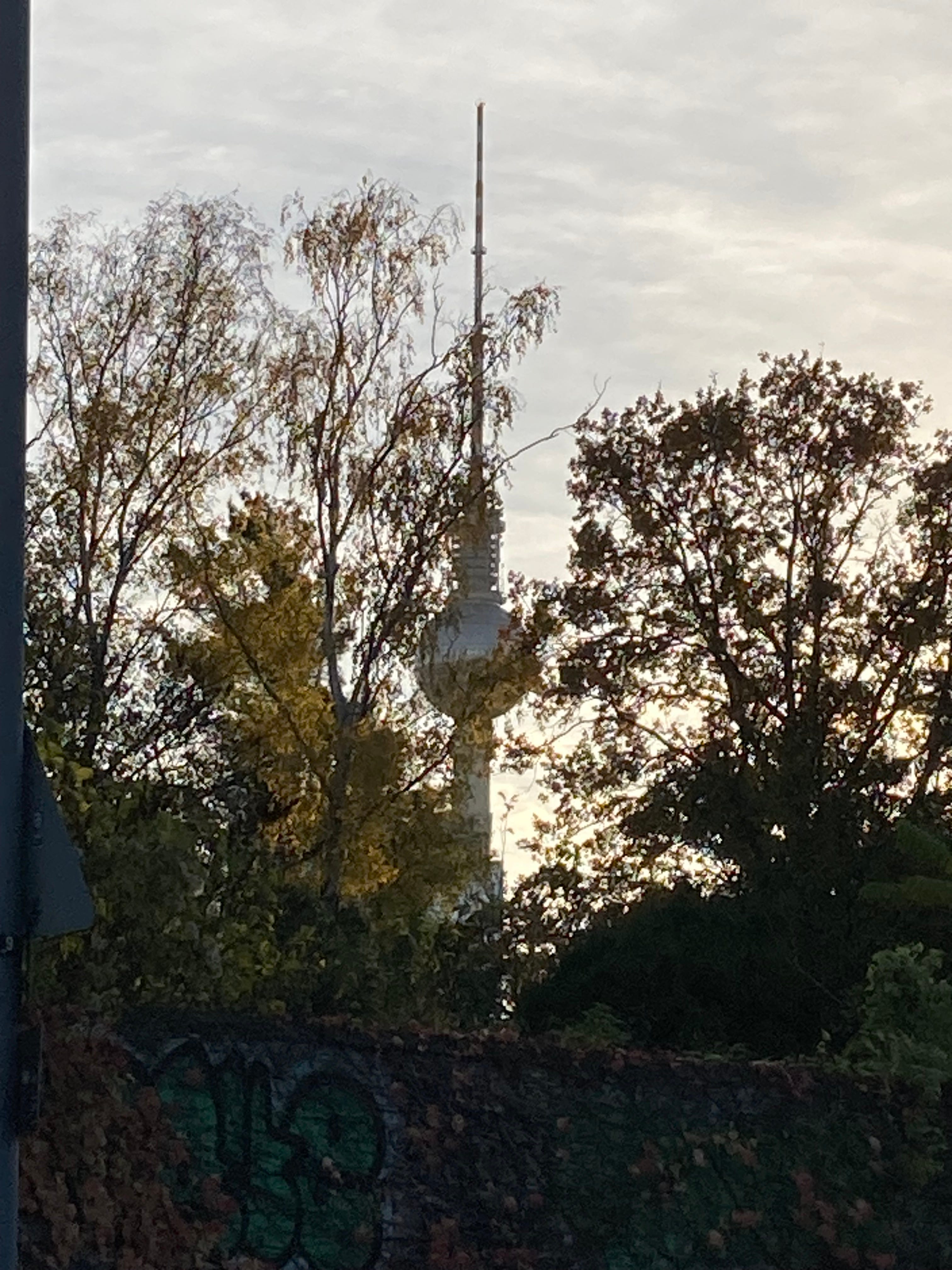
The Fernsehturm in fading autumn light
Of ringing light on the gold-fading trees, of shrubs burning red along this fence or that wall. Festooning the fence above the railway line in cosy, village-like Dahlem, for example. Or spreading along the brooding, graffiti-adorned walls of the cemetery at Friedrichshain, as you bomb past it on a bike for this or that meeting.
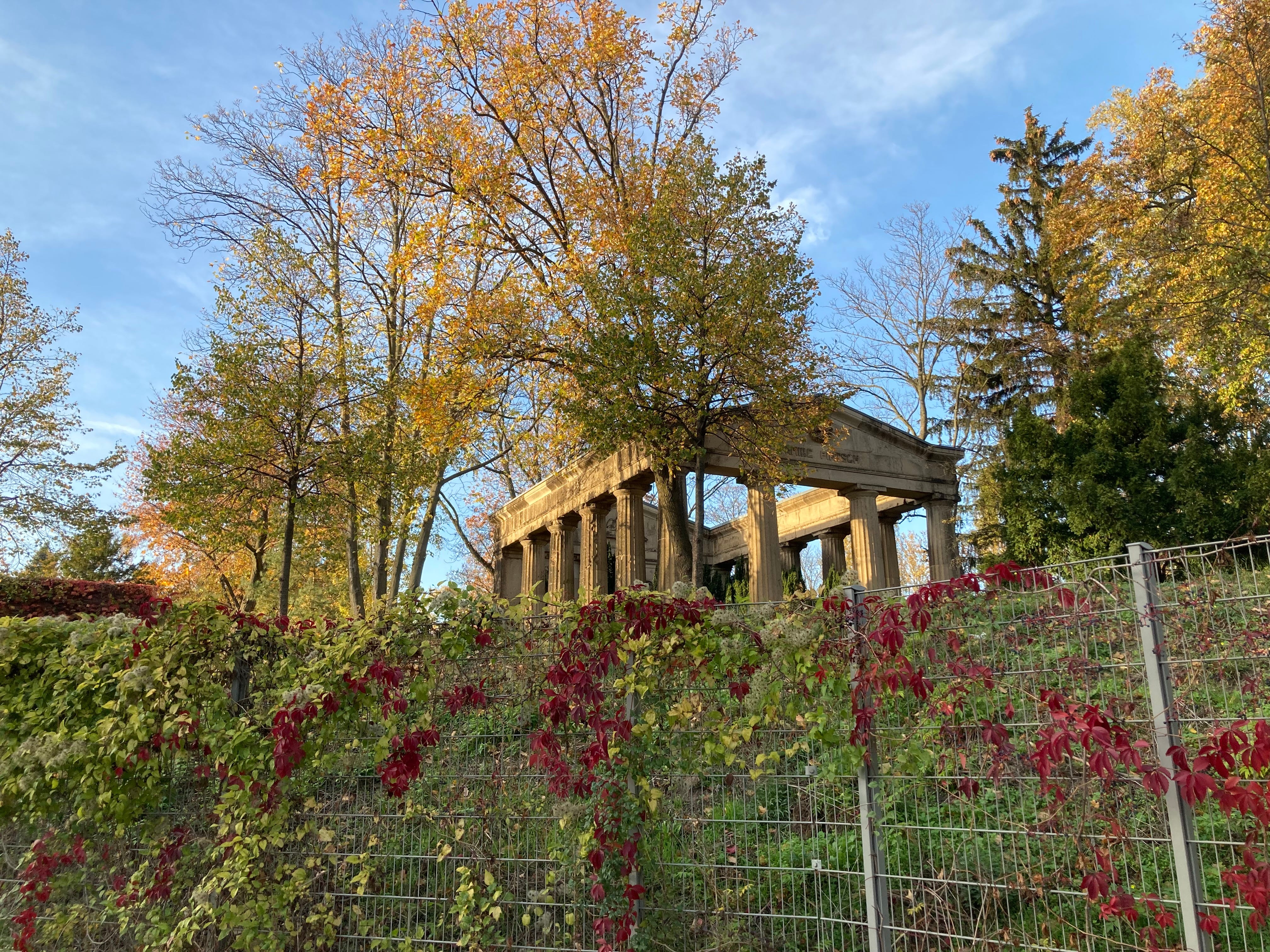
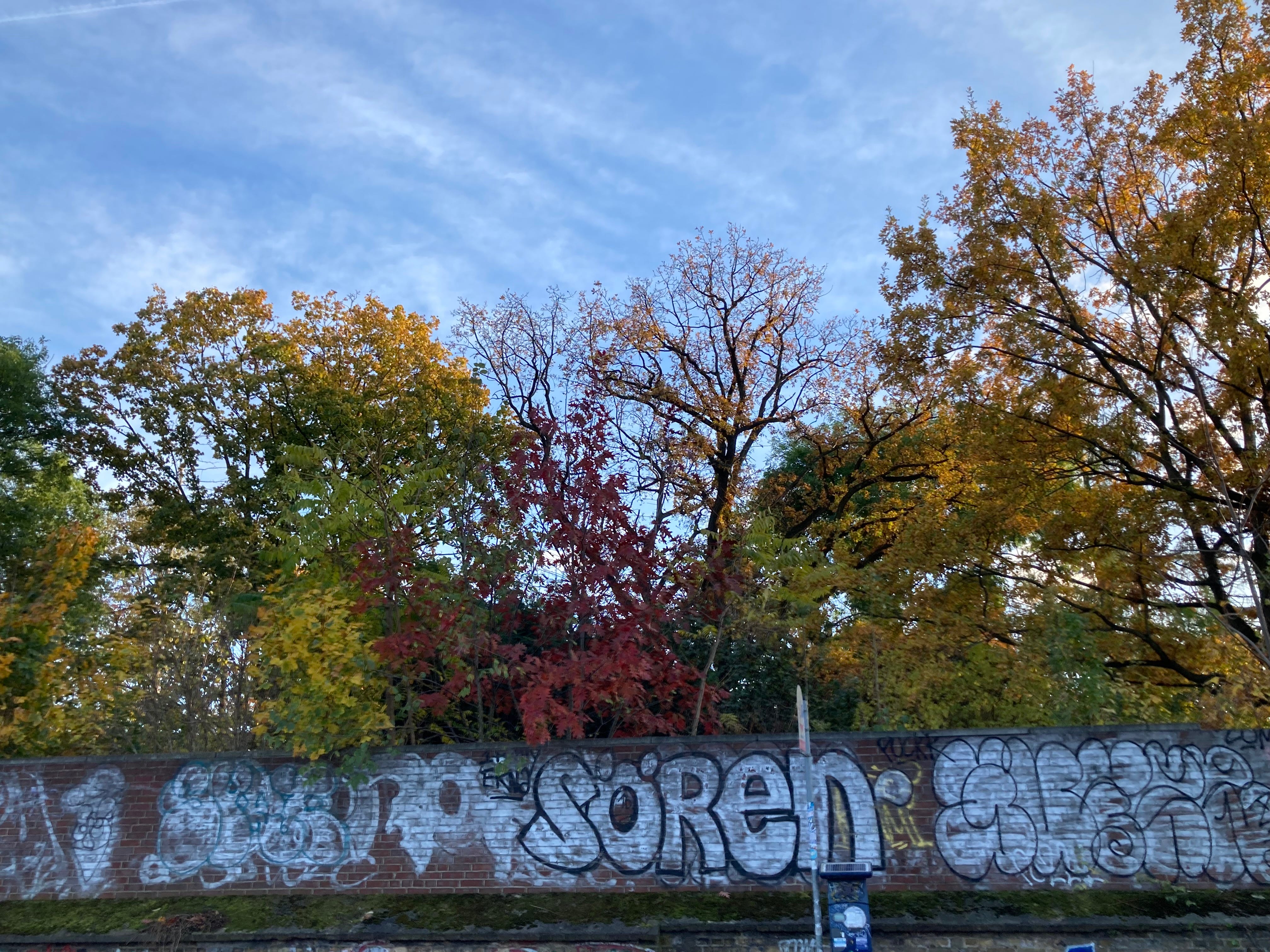
Cemetery views, Friedrichshain
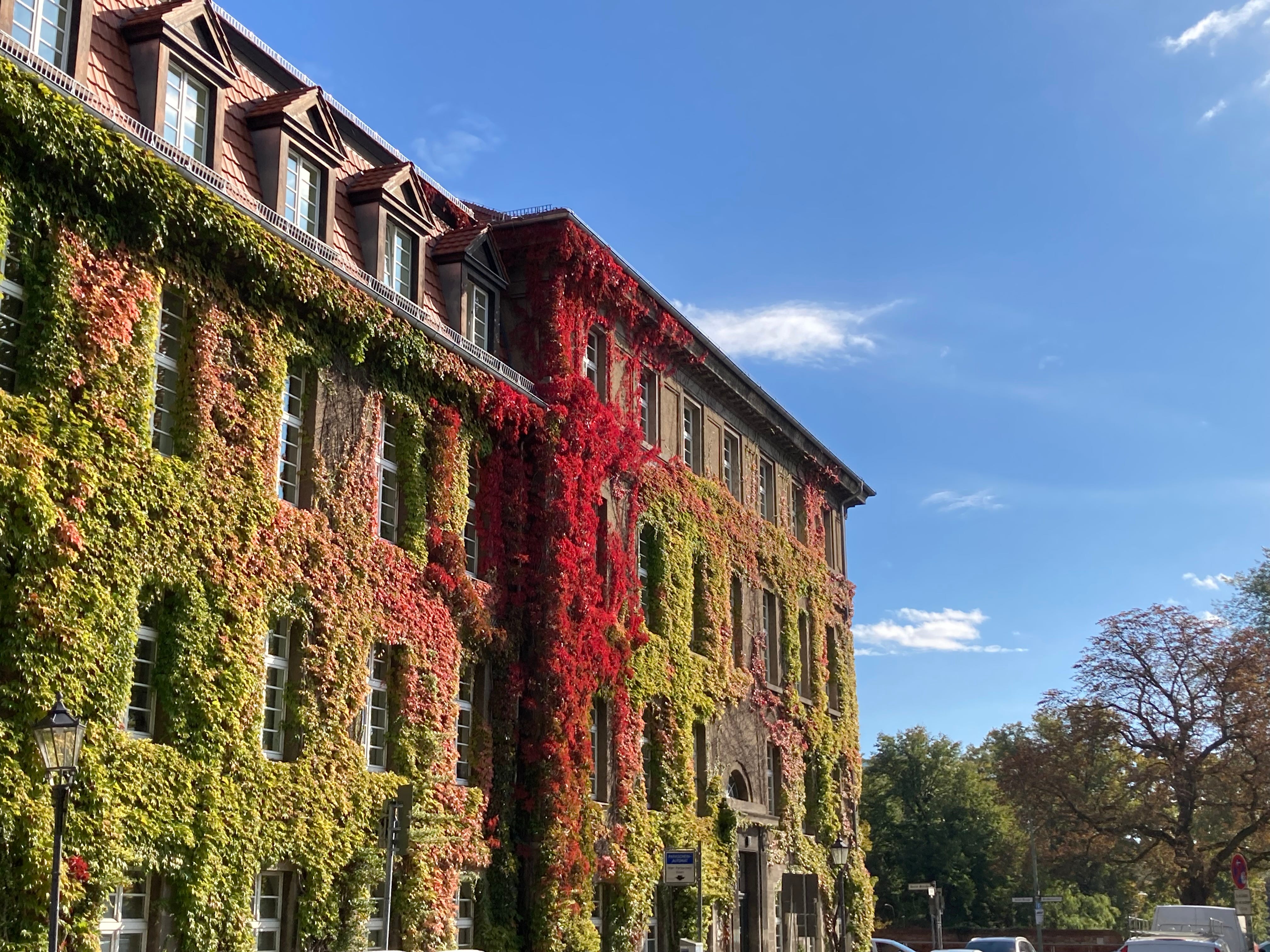
Rathaus, Spandau
Anyway, we’re back in the gloom now, the total grey, it’s seeped in as if for ever. And of course it’s dark practically by 4.
IMAGINED NIGHTS, IMAGINED LIVES
But then Berlin is surely made for the nights. If only, you feel, you could commit to that. Become completely nocturnal. Disappear into the alternative culture. Into an alternative culture, I mean – Berlin seems to be full of them. A world of art gallery openings, of chic late-night bars or performance spaces, of arts centres in converted breweries, of theatrical parties, spoken-word events, radical happenings.
It’s difficult not to feel a bit of an impostor, a spare tool, if you spend time in this city and aren’t part of some art scene, some sort of social activism, or lifestyle experiment. Or escape from reality. Or at least a start-up of some sort. Young people seem to congregate here from every part of the world, for all those reasons. In the hipper parts of the city, German has become at best a second language. You start to feel that you actually have to be young and enterprising and from somewhere interesting to belong here. (Rather than being – say – a middle-aged wandering scholar involved in an academic project so abstruse and antiquated that at times you struggle to explain it even to your colleagues.) They even seem to retain – these inexplicable young people – a sense of excitement, of fun and experimentation. It’s strangely enjoyable just to witness it, this bubbly naïve not-yet-disappointed sense of style and adventure. As they return from this or that bar, musical happening, club, or board-game meet-up, on a late-night U8 train. Or set off for another one. (Whereas in, say, London you’d surely find the equivalent youthful energy just annoying.)
In another way, of course, this is the most obviously backward-facing place in the world. The shadows of recent history – the War, the Cold War, the Wall – never far from sight. Constantly turning up in conversations, as they do in the very fabric of the city. Bullet marks still pock-mark the buildings in the centre that weren’t actually flattened. It’s intriguing to follow the old line of the Wall, as it criss-crosses the back-streets and main road, or skirts canals and (now) leafy parks.
Another foolish feeling that you (or at least, I) can’t entirely get rid of, particularly as you wander through the more down-at-heel areas, or sometimes those near the line of the Wall. (Where, in some places, the no-man’s-land remains abandoned and undeveloped to this day.) The feeling that you’re going back in time, sinking into the world of the cold-war spy story. That these shabby, dimly-lit, retro-furnished bars that you find yourself in must be – or really ought to be – the scenes of treffs, of tradecraft, of dead drops, of mysterious goings-on in a hidden back room, of top-secret microfilms.
Whereas – again – the closest I actually come to top-secret microfilms is the collection of ancient Greek medical manuscripts housed in an archive of the Berlin-Brandenburg Akademie der Wissenschaften. (Admittedly itself a place of some mystery and intrigue. And one which is rumoured, in its previous incarnation under the DDR, tohave had Stasi operatives in some very high-up places.)
THE KIEZ
Everyone who stays here more than a few days starts to have a favourite Kiez. Mine is ‘Kreuzkölln’,[1] or more specifically the ‘Gräfekiez’ – the block of streets surrounding Gräfestraße, on the edge of Kreuzberg, just south of the canal.
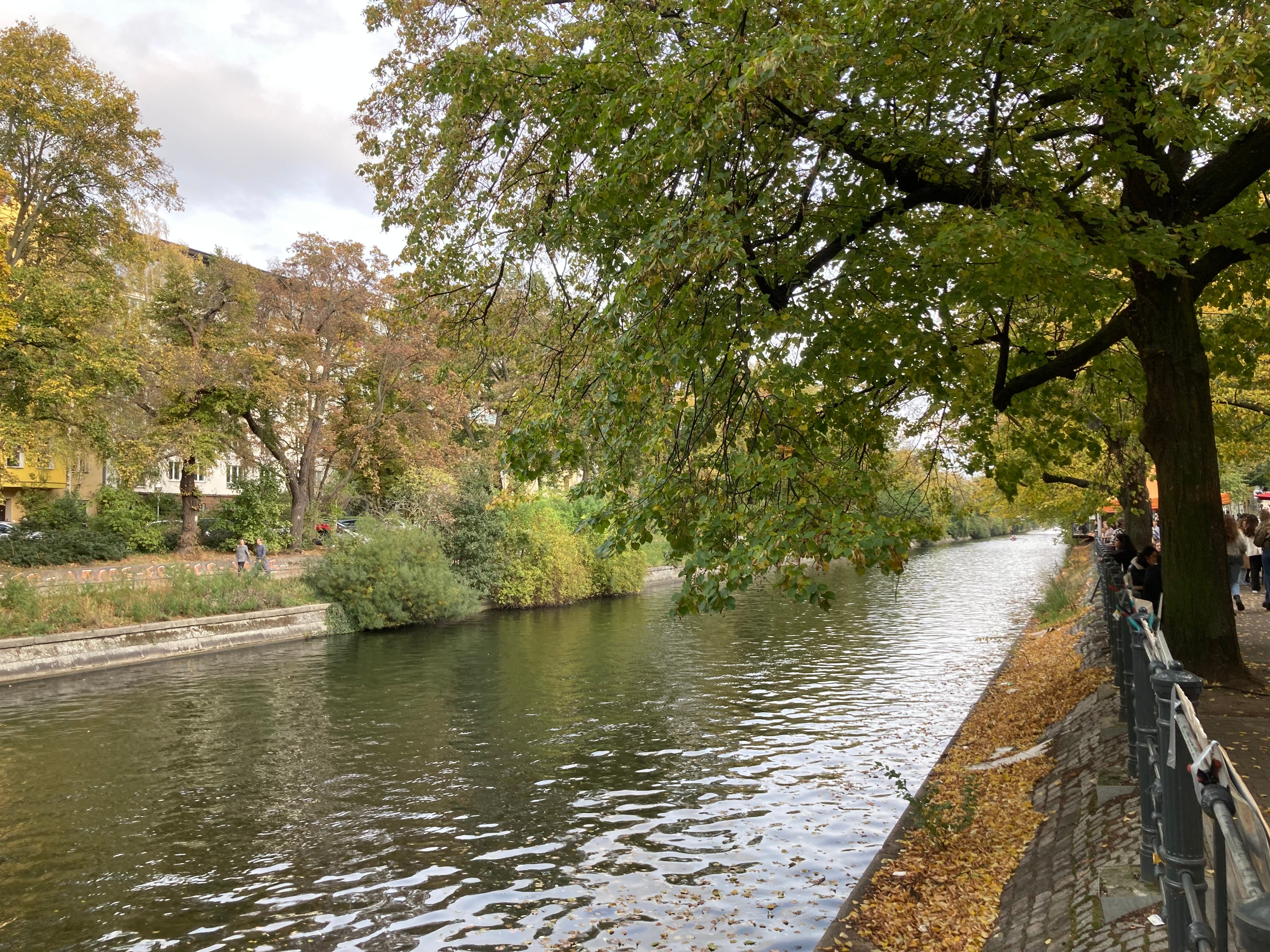
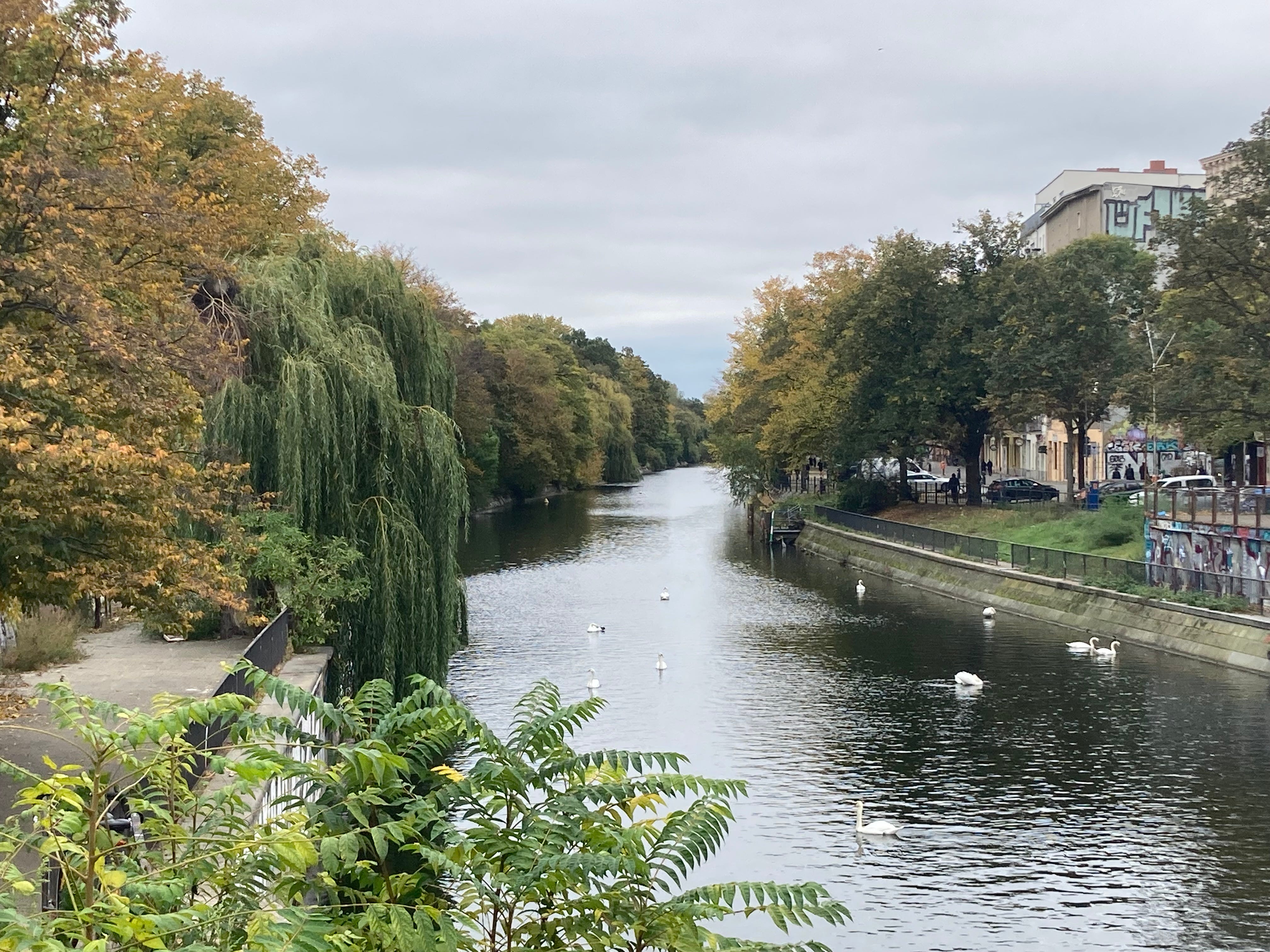
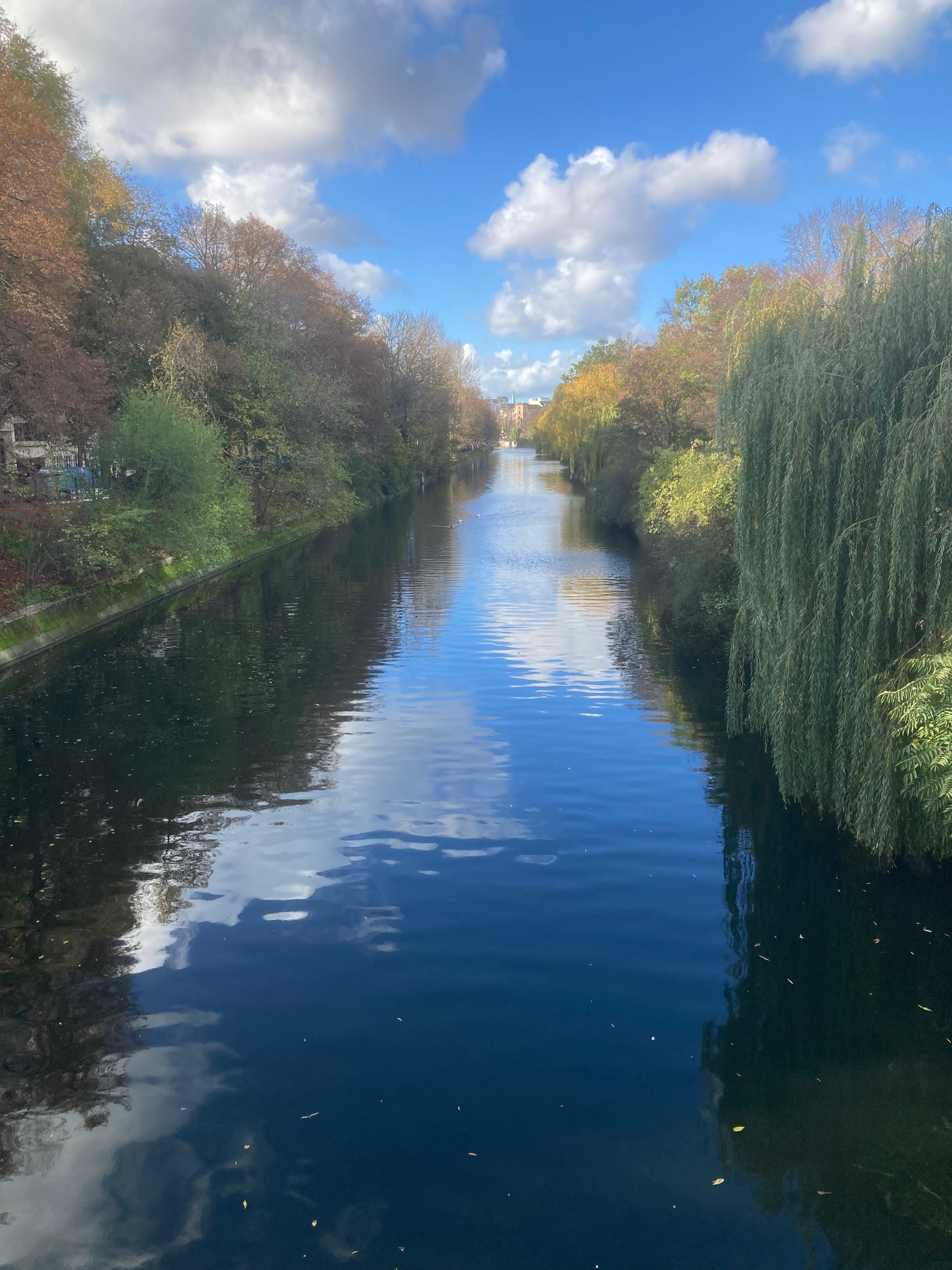
Views of the Landwehrkanal, Kreuzberg; close to the site of part of the Wall
But how to capture it, the character of this Kiez that I’ve become so fond of? Its peculiarity, its variety, its chaos, its strange quirky liveability?
The standard historical-demographic remark to make are that it is a traditional working-class area with the addition of large immigrant, especially Turkish, population. That its geographical position, central to the city but right next to the Wall (on the western side), led to low rents and structural neglect during the Cold War period, followed by substantial reversal of that situation once the Wall came down. And that all that has given the area its distinctive character – a blend of multiculturalism, alternative arts scenes, political engagement and, more recently, gentrification.
But none of that, somehow, captures the real everyday thing. The everyday jostle-along chaos and brightness, the mad variety of food outlets, the eclectic variety of bars, cafés, shops, that emerge at irregular intervals in amongst the grand, sober – and some not so sober – ‘Altbau’ (old-style building) blocks. The fun of the canal. The heaving variety of life up and down the main drag, Kotbusserdamm, which connects the U-Bahn station Kottbusser Tor, famous for down-and-outs and drug users, with the bustle of Hermannplatz.
It’s not for everyone, of course. Many of my soberer – and even some not particularly sober – friends prefer the more settled calm and elegance of Charlottenburg, or some other point further west. Even some people who end up here feel the same. A woman who works in my favourite Italian restaurant here, the small-scale artisanal ‘Pasta Factory’ – a place for me emblematic of all that I love about the area – tells me she would rather work anywhere else. That she hates the dirt, the chaos, the absence of order.
You cross the main street, Kotbusserdamm, and pootle down towards the Maybachufer, the nearest stretch of the canal. It’s chaotic, full of life, beautiful in a peculiarly Kreuzberg way; the canal itself is grand, with lovely views along its steep treelined banks, especially in autumn, and lined by tall stately Altbaus, and further down a huge ex-industrial building (now divided up into trendy restaurants, workshops etc.) on the other side.
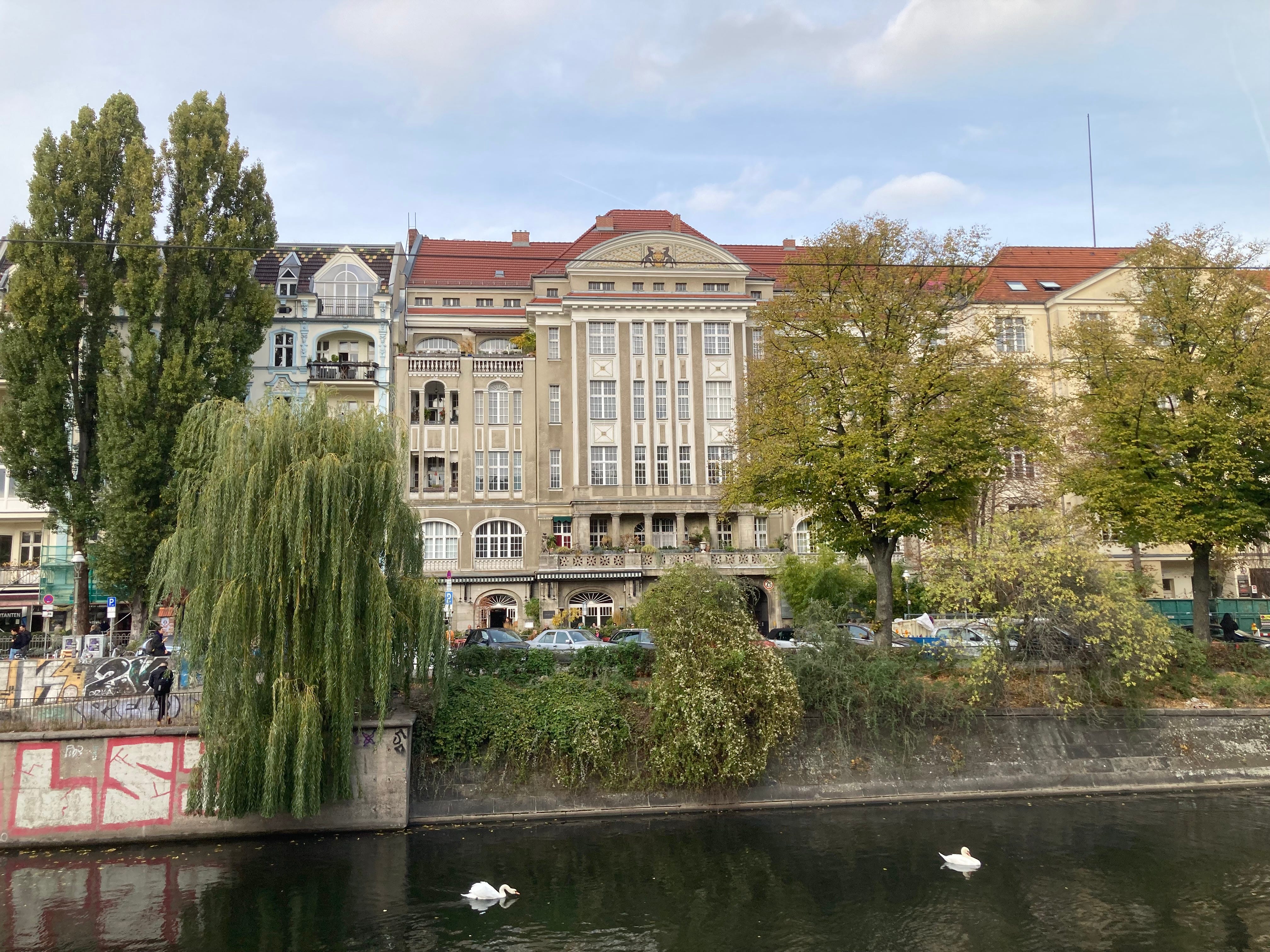
Grand Altbau on the Landwehrkanal, Kreuzberg
There are swans and graffiti in the distance; there are cyclists bombing past (or trying to) on the cobbles or pavement, towards the centre in the one direction or in the other towards the wilds of Neukölln; there are a few random people selling things on a street corner, there are young people of all nationalities smoking (almost never simply tobacco) on a bench. There are even, somehow, a couple of tents with rough sleepers, clinging onto those steep tree-lined banks. And, dotted along this side of the road, a sprinkling of cafés and eateries, a random selection of shops (a wine boutique, a shop with spools of fabric ...).
The focal point is the twice-weekly market, a teeming hybrid of mainly Turkish vegetable stalls with all variety of familiar and unfamiliar produce at ridiculously cheap prices, purveyors of various forms of world food, and retailers or more or less artisan items, from hats and scarves through soaps and jewellery to knives and carved wooden things. A young woman from Totnes sells gems and pieces of jewellery mainly from India and Thailand (having made the alternative, but in context conventional, lifestyle decision to follow her parents into this business).
Along the way to the canal, you pass a variety of traditional Altbau apartment blocks, some huge, some quasi-Gothic palaces with brightly coloured brick or stone, extraordinary architectural fantasies, many with bizarre sculptural decorations, from shields to birds and animals. (Some sporting displays of plants, some sporting grotesque gnomes on their balconies.)
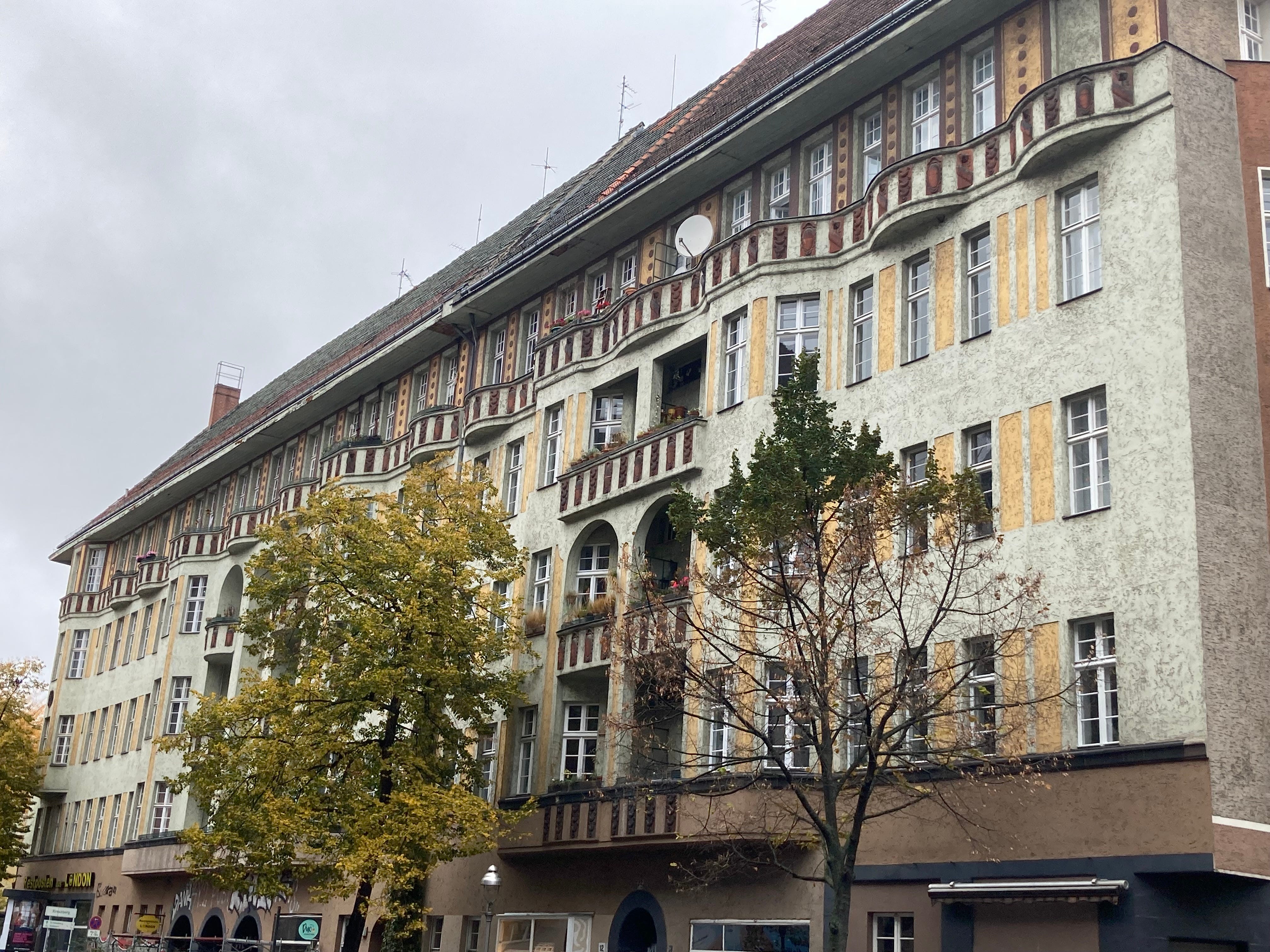
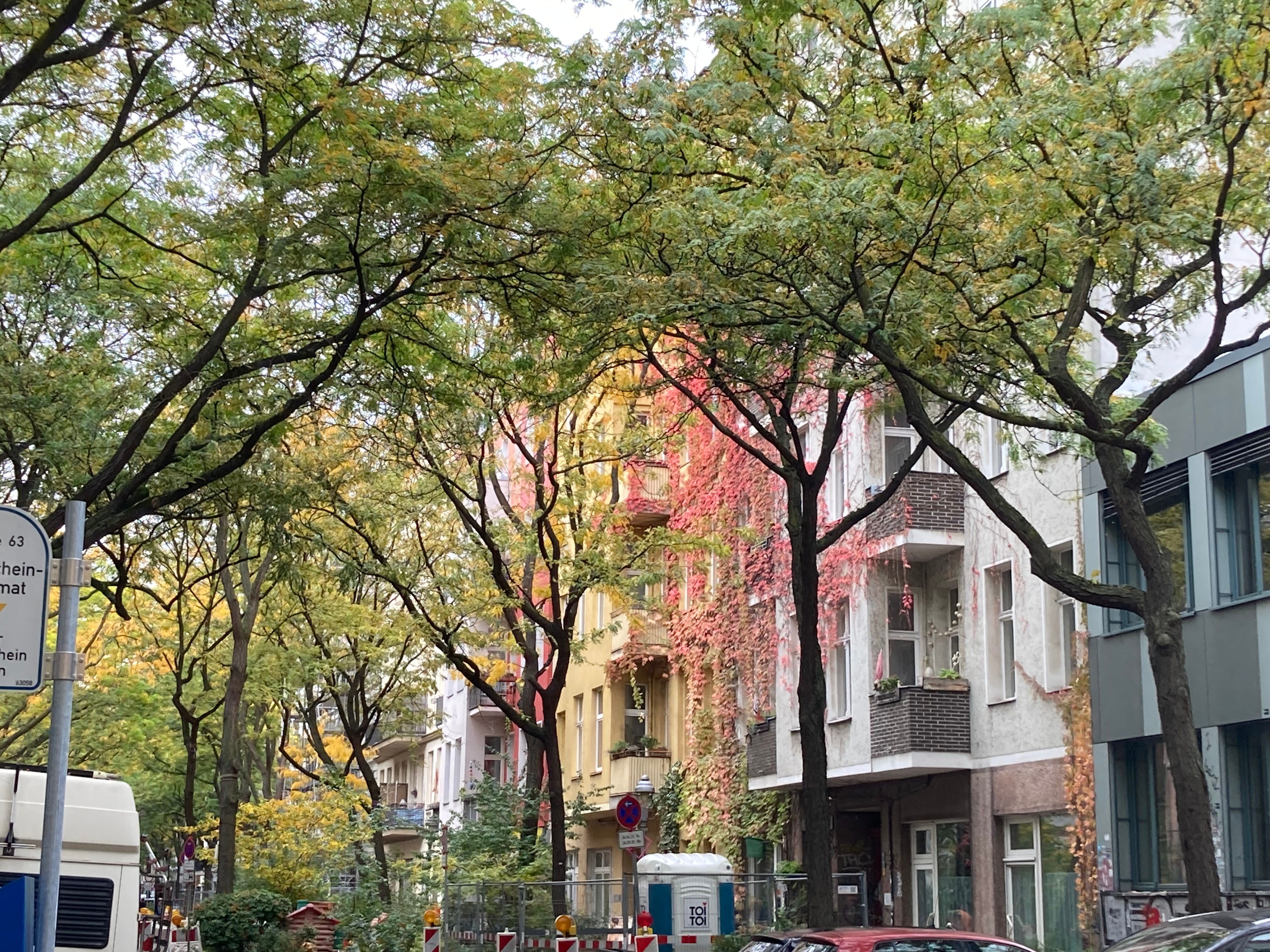
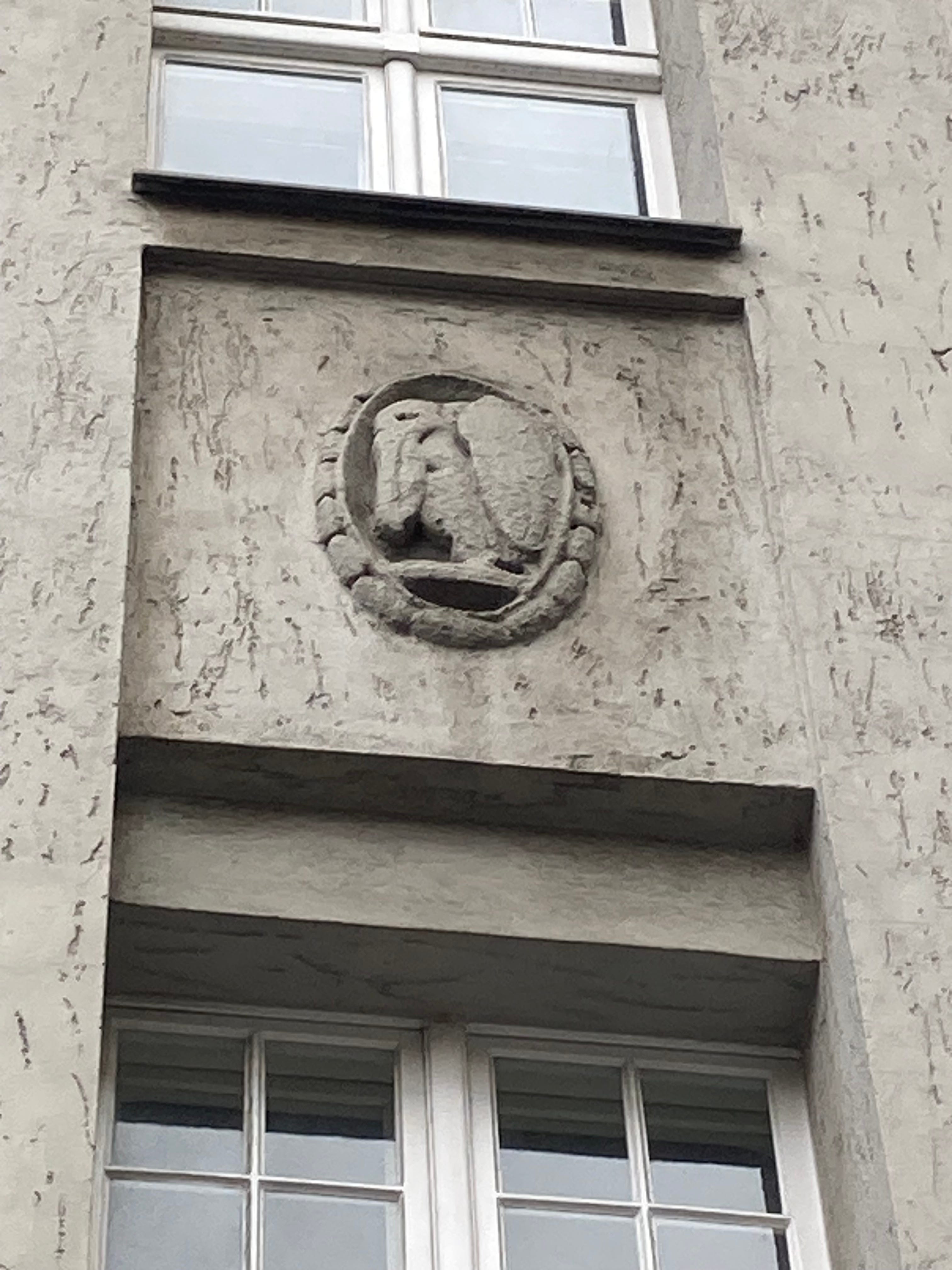
Altbau Curiosities, Kreuzkölln
Interspersed amongst them, every few doors, the motliest array of shops pop up. A vintage record shop; a beautifully laid-out bookshop; a purveyor of south Asian foodstuffs; an Italian food boutique; at least four vintage clothes stores, most of them apparently majoring in leather jackets. Several cafés, all with their distinctive vibes. That shop that creates and sells theatrical marionettes. Another bookshop, second-hand, chaotic, with a remarkable book tree installation rising on the pavement outside it.
Or you turn in the opposite direction, away from the canal, retreating into the heart of the Gräfekiez. You pass kindergartens existing in front rooms on the street, schools in grand nineteenth-century buildings, charming if slightly random bits or urban community garden reclaiming bits of the pavement, corner shops, shops specializing in hats, in liquorice, in second-hand children’s clothing, in Italian cakes. A treasure trove of a second-hand bookshop with a bizarre sort of sculpture, or tree, fashioned from old books outside its front. And of course, again, the succession of eateries and cafés with their subtly different vibes. And from here you could veer left towards Urbanstraße (possibly allowing yourself to be waylaid by the wonderful artisan Albatross Bakery) and down towards the heaving multiculturalism of Hermannplatz, epicentre of all the most turbulent political protest marches. Or, choosing the opposite direction, weave back to a different stretch of the canal, at the Planufer, grander, more imposing, more leafy, more swans.
Or for the moment remain where you are, in the depths of this cave-like hipster café, encountering dogs and children, intermittently overhearing snatches of conversation, glimpses of exciting lives; forgetting what you’re supposed to be doing next.
Another time, at night, along one of the ramshackle trendy streets that goes perpendicularly off Kottbusserdamm, then slipping right into Hobrechtstrasse. How often you’ve got lost in this spider’s web. You are in your by now familiar haunts, you are somewhere in them … but as often as not you don’t know where you are in them. You are highly capable of forging off in the wrong direction for quarter of an hour and finding yourself south when you thought you were going north, east instead of west, in the depth of the grid of streets just off Sonnenallee when you thought you were getting nearer to the canal ... or vice versa … or just in a completely other part of Neukölln.
How dark they are, these streets – dark without being threatening –, how mysterious, how coldly welcoming, how, occasionally, frightening, the disjunct series of bars you pass, as you consider your next move.
THE BARS
Ah yes – the bars.
There are so many to choose from … and yet …
It’s definitely an irony that in a city full of bars, including some of the coolest, oddest, most curious and most likeable, I find myself living directly opposite the least obviously likeable bar of all. It does, however, provide a considerable, if not quite consistent, level of amusement.
I refer to the quaint, but also very down-at-heel and sleazy-looking Bei Schlawinchen,[2] in and out of which go the widest variety of people in the widest variety of states of excitement or inebriation, at different frequencies throughout the 24 hours.
And it’s not that a 24-hour bar directly opposite your flat disturbs the sleep, not that it produces constant noise in the night. Oh, there are occasional noises, fracas, incidents in the night, for sure – there was even the occasion when the emergency services attended, and seemed to be tending to a large number of people’s eyes (what on earth had happened? had someone in the bar randomly pepper-sprayed a whole load of people?). But no, it’s the mornings above all that give rise to weird, noisy and anti-social behaviour. In other Berlin bars there are strict instructions posted asking people to be quiet when leaving the bar after 10 pm. Here, it would be useful if a similar restraint were imposed on people leaving after 7 in the morning. Individuals and groups come out shouting or singing at any time from early morning until midday. There are altercations. There are strange repeated non-verbal animal grunts or moans. These reach me, in my semi-somnolent state, with a strange sense of repetition, of familiarity; as if the same non-verbal grunt or moan is being emitted, the same intoxicated or mentally disturbed individual leaves the bar, or is just drawn to its environs, at roughly the same time in the morning. Probably it isn’t. Perhaps there is a kind of desperate, lost-all-sense-of-reality animal moan that is the common fate of all, or at least of many, who have drunk in such a place for so many dreadful hours. Or perhaps there is such a man, a tormented soul, always drawn back to the bar, almost always emitting his moans at 8, 9, 10 in the morning. Perhaps he has no connection to the place, it is just a passing Kreuzberg moan. (We are, after all, a stone’s-throw from the Schönleinstraße U-Bahn station, the hub of all outcast life and drug-taking.)
Then there are the more carefree groups – the place is clearly well-known in online literature, as the one reliable destination, the place you can go when you’ve been clubbing all night or thrown out of any other late-night bar. Groups convene outside it on the street, after (presumably) very many ales, apparently just chatting, trying to work out their next move. A bunch of young to middle-aged women – for some reason I take them to be an Irish hen party – forms a sort of line and engages in a mixture or singing and shouting.
A couple of young men prop themselves up against the wall of the place while they smoke and attempt to conduct a discussion which may be about the exchange of drugs, about their next port of call, or perhaps about issues far deeper, far profounder. Sometimes there is a fight. On one occasion a man staggers along the pavement so circularly, so unconscious of his own condition, so obviously about to fall that I wonder briefly if I shouldn’t run down and ensure he doesn’t do so in the road. But he is soon asleep again on the pavement.
Intermittently amidst all such events the spikey, energetic barman comes and goes, torn trousers and sleeveless vest in all weathers, something approximating a mullet on his head, collecting jars, moving objects, encouraging people or preventing them from entering.
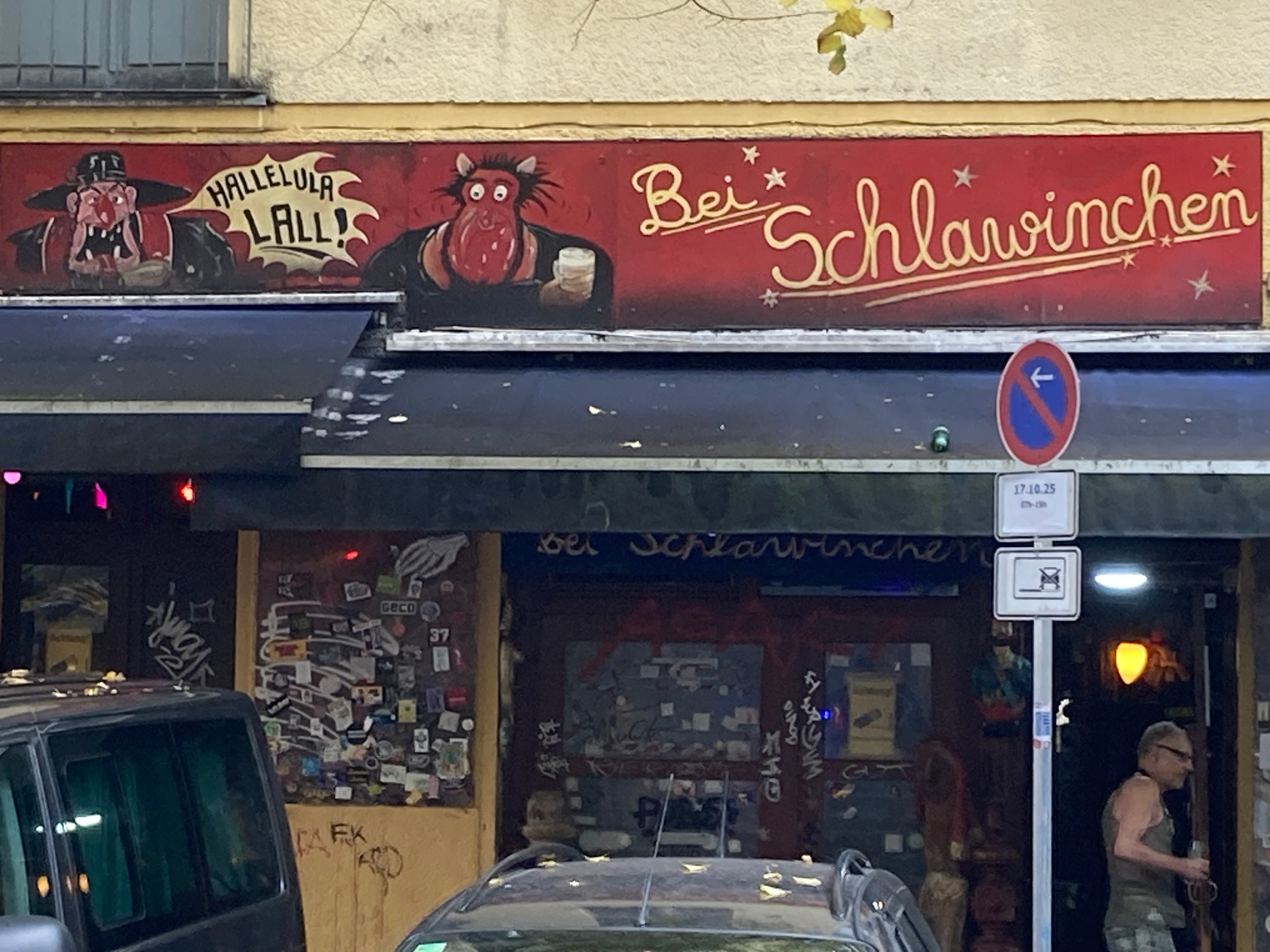
The Scary 24-Hour Bei Schlawinchen Bar
But why have I spent so long describing this admittedly entertaining dive? It doesn’t have to be so. There are so many other possibilities. The understated elegance and calm of Il Kino, for example, a tiny Italian-run art cinema-cum-cocktail-bar close to the canal, the walls adorned with east European versions of posters for classic art movies. The mysterious gloom of Thelonious, in Neukölln, with its attention to cocktail art. The smoke-filled Zum Böhmischen Dorf, with its unpasteurized Pilsner ‘Tankbier’, beautifully refreshing in the summer. Or, a bit further north (near the notorious open-air drug market that is Görlitzer Park), there is Hopcraft, offering more of a pub vibe and a pleasing variety of ales. Or, again back in Neukölln, there is Geist im Glas (Spirit in the Glass) or Der Dschungel (the Jungle). These and half a dozen similar bars in the area are pleasant, dark, ‘alternative’, dives, where you can enjoy cocktails served by ridiculously trendy youngsters, converse late into the night and inevitably losing track of time, 2 or 3 in the morning being a perfectly normal time to be still hanging out in this neck of the woods.
There are many more or less experimental relatives. Several of them look like someone’s front room from a few decades ago, with retro sofas and odd memorabilia. One such is so laidback and so like someone’s abandoned front room that it seems to have forgotten to stock anything we would want to drink, and we have to turn our alternative steps elsewhere.
On one particular evening a friend is visiting, and we surge into the Kreuzberg night in search of an appropriately attractive but also talk-friendly bar.
We find ourselves outside a ‘gallery’, with clearly a party buzzing inside. The gallery is simply someone’s room on the ground floor facing the street, but inside something unusual is going on. Something tremendously joyous and camp, and distinctively Berlin. I must have passed this place before, observing without stopping to wonder at its over-the-top pink frivolity behind an ordinary door. It happens a man is outside having a cigarette; he explains. The hostess is an artist, a painter, who also sings and dances. Here, every Friday and Saturday, she keeps open house; people come, sing, listen, play, dance, in the tiny space of her gallery. It is, he says, a bit of the old Berlin – one of the few left. Very slightly tempted to enter, we nevertheless pass on, in search of a bit of a slightly newer Berlin.
We hit upon Oblomov. Who knows the origin or intention behind the name. It is true that there is a Russian comedian who runs a regular comedy event here, and indeed ‘English Comedy Tonight’ is blazoned outside the pub – as it is outside so many bars in the district. Comedy is long over for the night, but we sit in the space which was presumably the auditorium, with a curtained stage area the other side of the room, catching up, energized, talking, drinking red wine in the semi-darkness, surrounded by the young.
The curtained room, the stage area, seem an almost constant feature of bars in the area – they almost all look like performance spaces – so that it’s often not clear if they actually host live performances or not.
SPOKEN WORDS
But some definitely do. I delve into the world of English-language comedy and spoken word. And encounter a teeming and bewildering subculture. There are many venues – all intriguing in their different ways. And some not a little disconcerting.
One occupies the main room of a large boat on the river, just next to a stretch of old Wall. Most are small back or side rooms of pubs. Some extremely small.
There’s a huge range – of styles, abilities, vibes, above all of nationalities. Regular events are hosted by a Romanian, a Bulgarian, a Scot, an Australian … and so on. Few performers have English as mother tongue. The intensely youthful multi-culturalism already noted is on show here – in wildly concentrated form.
The events range in ethos. There’s the tremendously welcoming – and intensely ‘woke’ and safe-space-oriented – Berlin Spoken Word. Hosting a huge diversity of backgrounds and performance styles. Though inevitably certain core themes emerge: childhood trauma; relationship break-up; issues of sexuality and gender. Then there’s a plethora of little venues devoted simply to stand-up comedy. Here, by contrast, there seems genuinely to be no taboo, as if to counterbalance that other sub-cultures’s concern about ‘triggering’. But at the same time, there’s little sense of the threat of casual humiliation of random audience members that is part and parcel of the UK comedy club. The MC routinely engages in a little crowdwork, but usually in a fairly cursory way – no one’s heart is really in it.
The same set of issues are to the fore here, too. Though now of course with more of an attempt to find the funny in them. And alongside them, the near-universal theme of cultural difference. German comics, for example, almost always major on the perceived irony of a German doing comedy – and on the unresponsiveness of the German comedy audience, their congenital and irredeemable unsuitability for that role. Performers from all over the world lead with their own background and upbringing – the comedy potential massively enriched if the two parents happen to be of different ethnicities. (Sometimes you cynically suspect that the parental pairing must have been invented for the joke. One performer – can this really be true? – but my memory tells me so – claimed a Norwegian father and Colombian mother. Which, naturally, had left him with a hugely complicated attitude towards snow …)
I can’t help seeing an irony here. The more ‘diverse’ the performers’ backgrounds, the more they tend to rely on that as the basis of their material – and thus make themselves just like every other performer. Start with your ethnic identity and sexuality, throw in a couple of facts about your family background, lightly satirize and exaggerate these, play with the audience’s stereotypes and preconceptions … and you have the basic structure for your comedy persona and set. At the same time are conforming to what is now the almost universal model in the professional stand-up world. So, really, the opposite of diversity.
Still, having said all that, these comedy events remain disarmingly and charmingly random and unpredictable. There survives some genuine diversity and experimentation, something oddly naïve and life-affirming, compared with their professionalized and mass-produced UK/US counterparts. Which is not to say that there isn’t an awful lot of shite. The price, perhaps, of an art scene still being young and experimental.
TWO WORLDS
But being, sadly, neither young nor nocturnal, I must drag myself away from these events, which promise to distend deep into the night. I seem to be torn between two worlds. It’s not the most comfortable condition. Still, you’re always left, at the end of the evening, with the feeling that something intriguing and new might be about to happen. In the midst of the very old.
[1] A ‘Kiez’ in Berlin is a local district or neighbourhood, something much smaller than the 12 Bezirke (roughly speaking boroughs) into which the city is officially divided. ‘Kreuzkölln’ is a popular amalgam word to refer to the border area where Kreuzberg (trendy/alternative/gentrified) meets Neukölln (trendy/political/alternative/not-yet-quite-gentrified).
[2] ‘Schlawinchen’: apparently the diminutive form of the word ‘Schlawiner’, meaning a sly or crafty person.