
In Candia
A Greek Interlude

THE WARM SOUTH
Oh, to escape southwards for a few days, from London’s intense autumn gloom. Or from Berlin’s even gloomier one. It’s a great trick if you can pull it off. A balm for the soul, really. I’ve managed to pull it off a few times of late, through the clever ploy of having a son working in Greece. Iraklio in Crete, to be precise.
And so, from the unchanging October grey to the world of outdoor cafés, of midday strolls along the seafront – even, rather miraculously, of an hour two spent on a beach lapping up the sun.
HERAKLION: VENETIAN AND MODERN
The modern city of Iraklio, or Heraklion – or Candia – has had quite a bad reputation. It’s tended to be seen as not exactly modern, in any positive sense, while at the same time as lacking in historical interest – or indeed physical attractions in general. The perception has been around for some time. ‘Altogether a nastier and less interesting Turkish town I was never in’, was the pronouncement of the English painter and nonsense-poet Edward Lear, who visited during the Ottoman period, in 1864. Large-scale destruction caused by bombing during the brutal Battle of Crete in 1941 did much to add to the negative impression, which is often that of a random collection of unattractive buildings thrown together in haste.
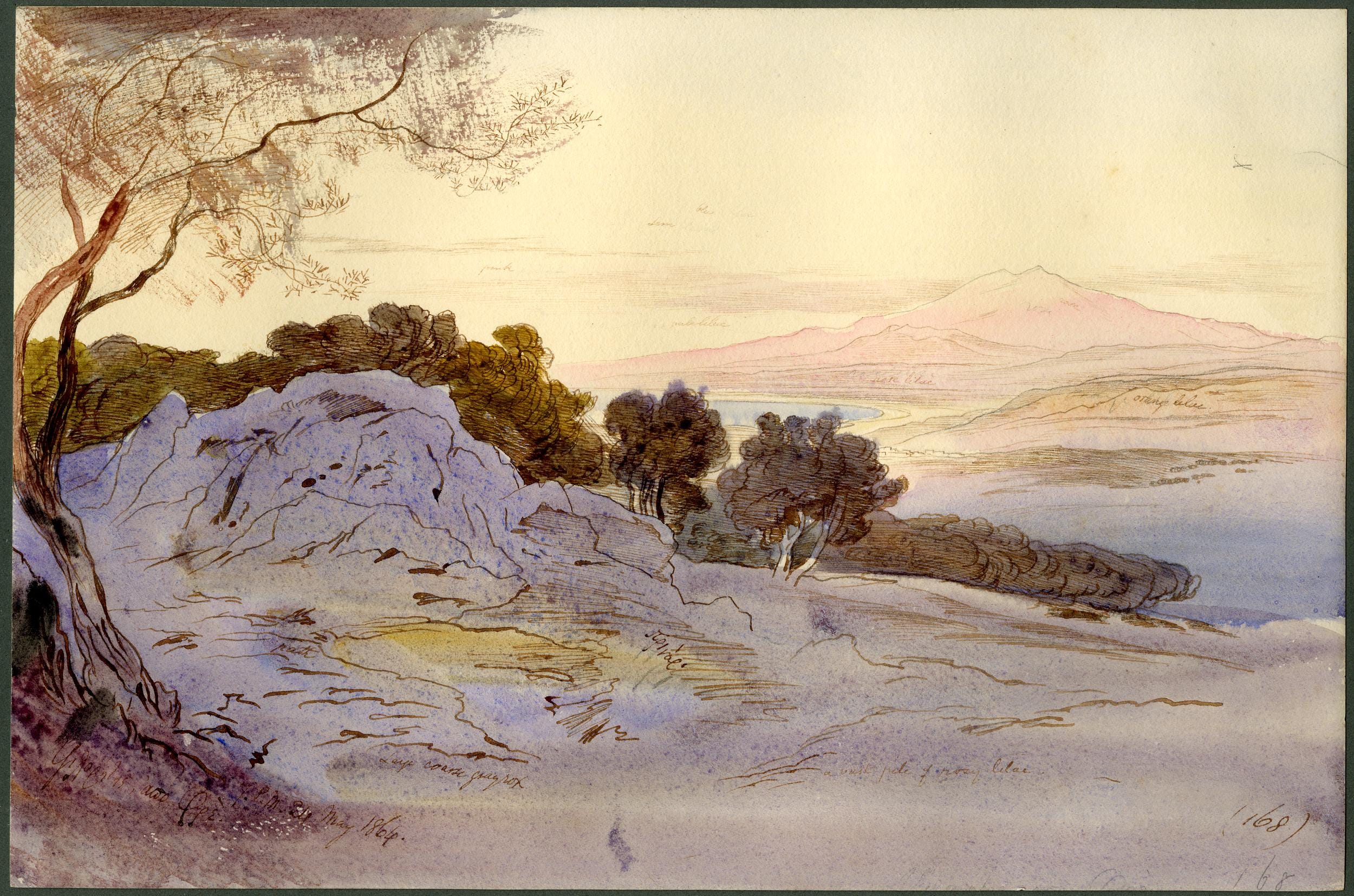
Edward Lear, Distant view of Mount Ida (Psiloriti) from Fre, Crete, 1864
© The Trustees of the British Museum. Shared under a Creative Commons Attribution-NonCommercial-ShareAlike 4.0 International (CC BY-NC-SA 4.0) licence.
But both perceptions – that of an out-of-date backwater and that of a chaotic eyesore – are in need of serious revision. The city boasts a number of delightful old buildings, mainly but not only from the Venetian period. Having recently visited Venice I feel the echo or shadow of that city accompanying me around this one. And somehow, the fact that it is an echo or shadow – the hidden, unexpected, surprising nature of the Venetian gems emerging between unremarkable 20th-century blocks, as against the constant supply of them in every side-street in Venice itself – is part of the charm.
The echoes as it happens are rather specific. In Venice I found myself intrigued by the chapel of the Morosini family in the church of San Francesco della Vigna, alongside the sombre tomb of a scion of that family; and here in Heraklion – or Candia – the name Morosini (albeit referring to a different scion of the family) is front and centre.
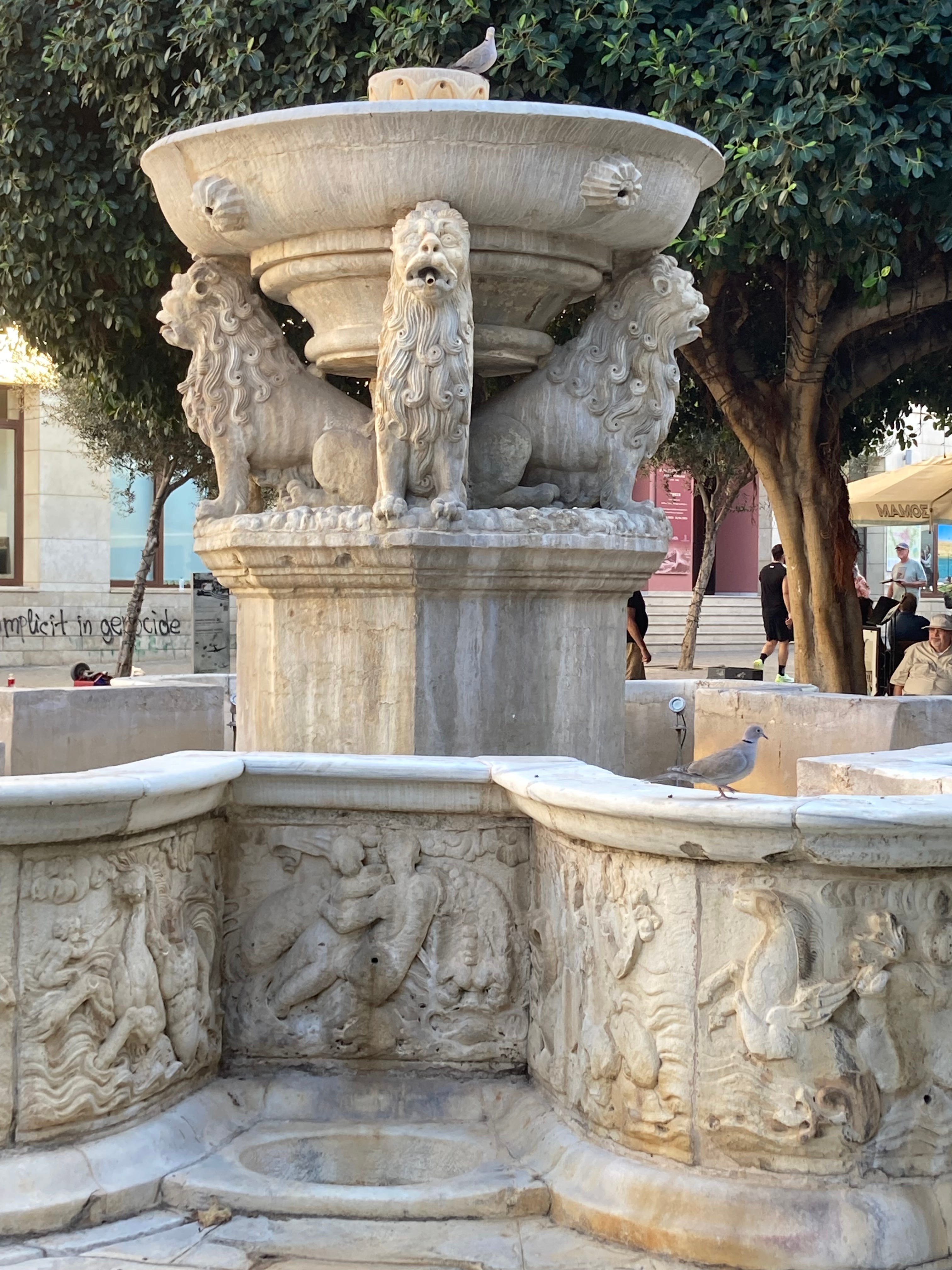
Morosini (‘Lions’) Fountain, Heraklion
The Morosini or ‘Lions’ Fountain is at the beating heart of the old of the city, the square it’s in heaving (I’m told) at more touristy or warmer times of year, and lined with shiny shops and restaurants. It’s named for Francesco Morosini, the Venetian governor, who had it installed to supply fresh water from an aqueduct in 1628. The fountain’s chequered history reflects that of the city: a statue of the sea god Poseidon which was originally its centre-piece was destroyed by the Turks (or possibly by an earthquake), who also transformed the design and removed much of the original decoration. After the end of Ottoman rule, in 1900, it was quasi-restored to its former state.
Then there are more Venetian palazzi, some inhabited by museums or official buildings. The other particularly delightful monument is the Bembo fountain, at one edge of the central area, in a spacious square frequented by leisurely pigeons. The Bembo in question (Gian Matteo) was another Venetian governor and water-provider, about 100 years earlier. Again the original construction has been overlaid by the Ottomans, who built a mosque behind it (long gone) as well as putting their own twist on the fountain edifice. Which has now undergone a still further transformation, into a café. And there are the sea-front fortifications and connected castle, which apart from the views houses an informative museum.
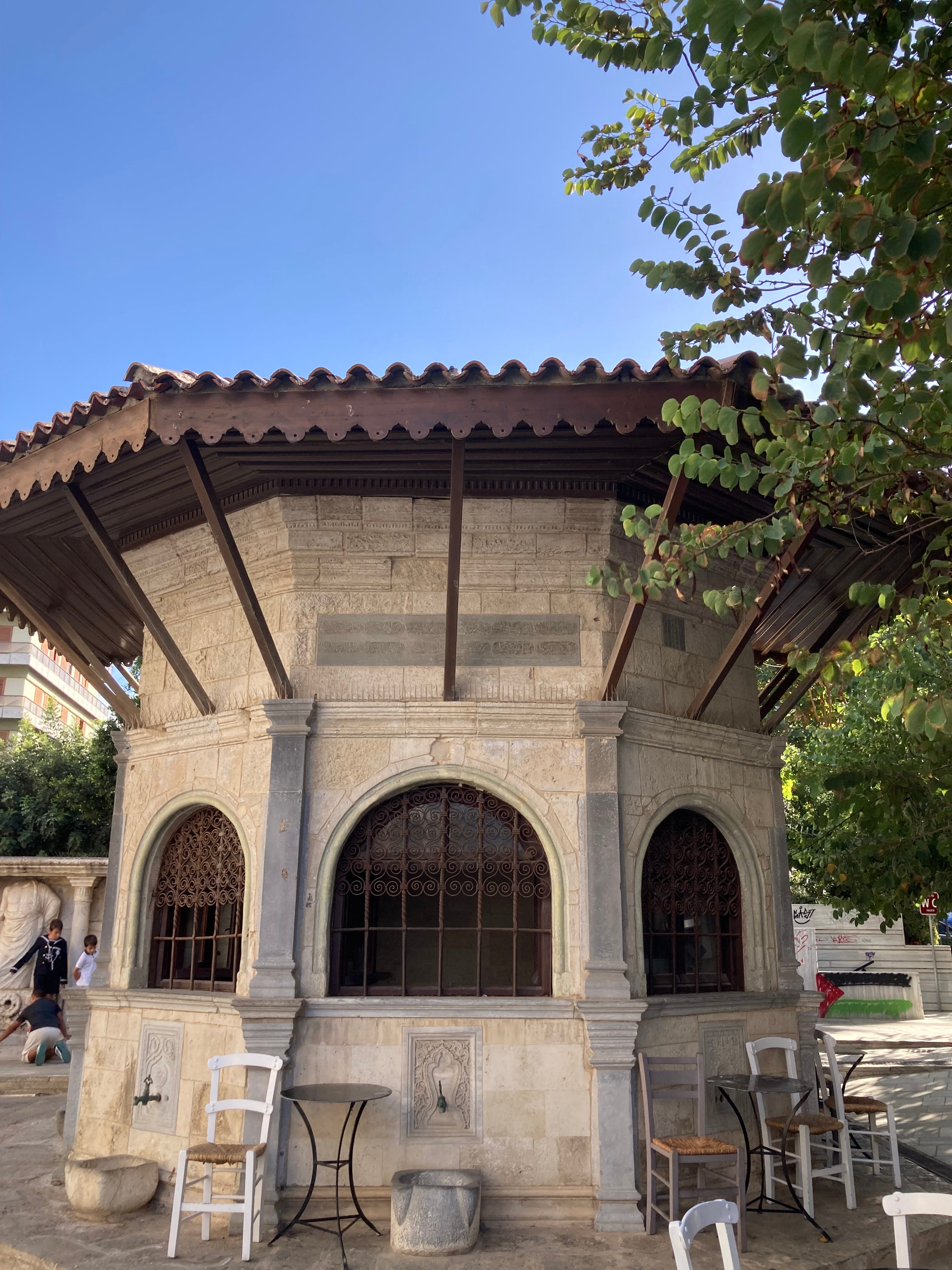
Venetian (‘Bembo’) fountain cum Ottoman fountain cum 21st-century café
Venetian costumes, emblems, flags – lions – peep out of you, from the stones of the city, here and there as you wander the centre.
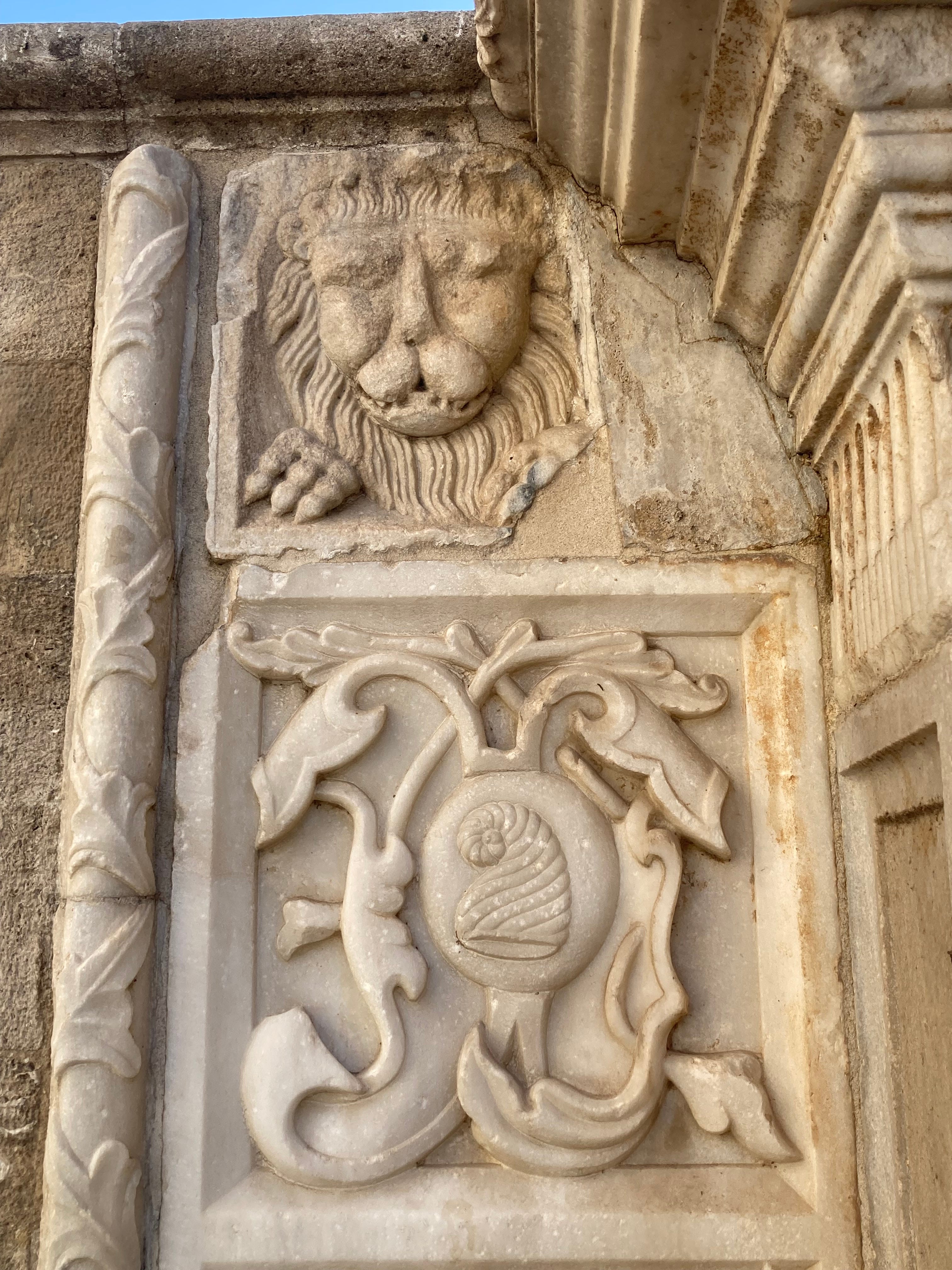
Venetian marble emblems at the Bembo Fountain
Another intriguing relic, fenced off on the other side of the road from the Bembo fountain, in a small bit of wasteland that is presumably looked after by the archaeological authorities, is a collection of Ottoman gravestones and inscriptions – largely stacked up against a wall but also somewhat scattered on the ground. And so is city’s chequered history engrained, rather chaotically, in its stones.
And, speaking of stones: Heraklion also boasts a tremendous archaeological museum, focussing of course on the treasures of Knossos and the other Minoan sites.
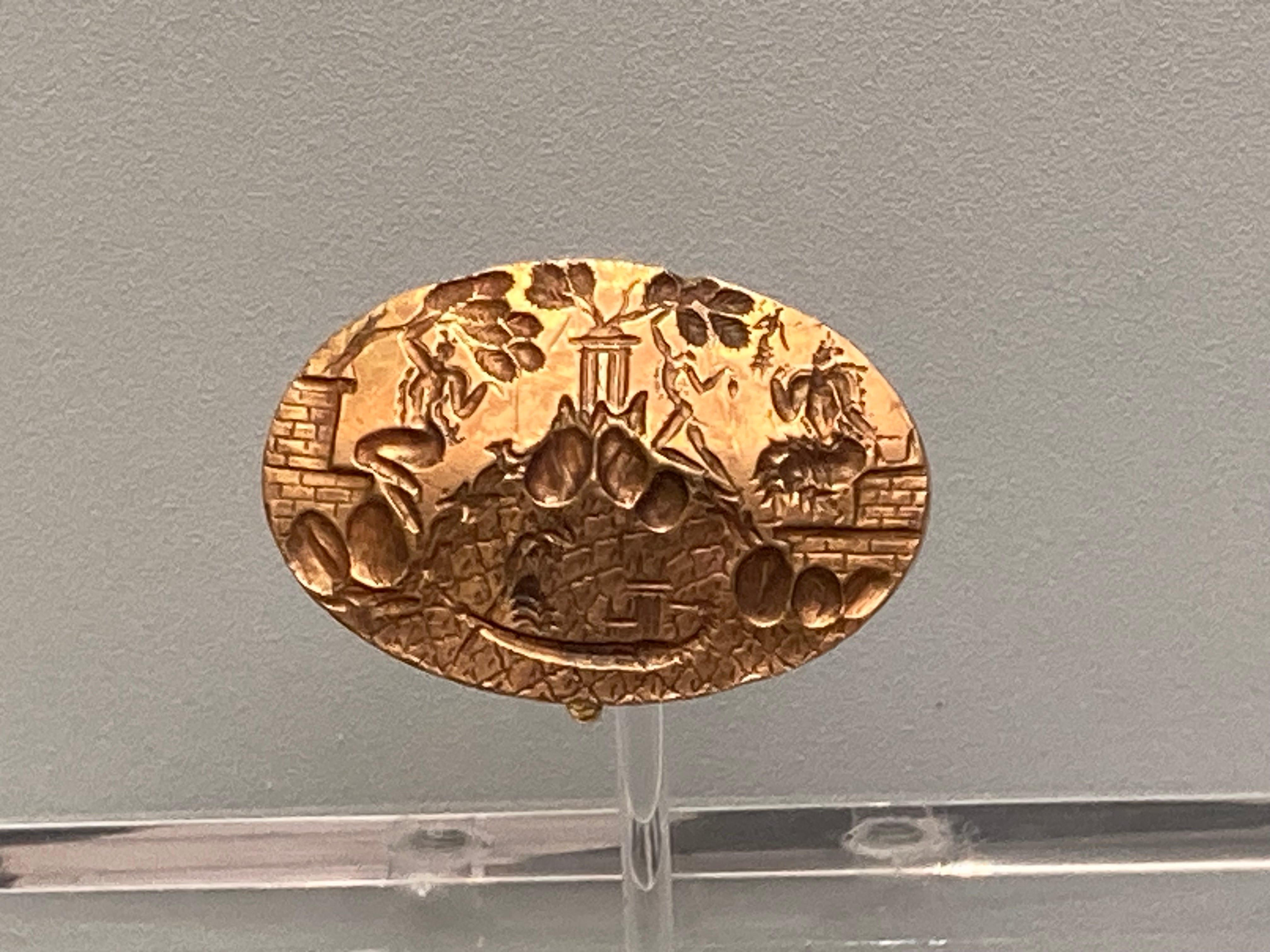
The ‘Ring of Minos’, c. 1450 BC, Archaeological Museum, Heraklion
PLEASURES OF FLESH AND SPIRIT
As for more modern accoutrements, the centre of town has a laid-back touristy-cum-studenty vibe, and is very well provided with trendy, relaxed cafés – not to mention relaxed and trendy people (not a few of them students) to sit in them. My favourite is Frankly, a third-wave coffee emporium with fine little pastries, on a corner, overlooking a church-cum-Byzantine-icons-museum.
There are even craft beer emporia and even specialist vegan food outlets. Indeed, it’s surprisingly easy to eat well as a veggie or vegan here, traditional perceptions of Greek food to the contrary. The new wave of purveyors of vegan burgers or wraps actually just supplement a food culture which already has plenty of plant-based delights on offer. Spinach, pumpkin or mushroom pies provide tasty lunchtime fare, while the wide range of traditional restaurant offerings includes the delectable starters fava (yellow split pea purée) and dolmades (rice-stuffed vine leaves) such wholesome stews such as fakés (brown lentils) and briam (roast vegetables with tomatoes), the old favourites gígantes (butter beans) and gemistá (stuffed peppers or tomatoes, sometimes also zucchini and aubergines), and a host of salads, not least the distinctively Cretan palikaria (literally ‘young lads’), a salad made with wheat berries or other grains and several different pulses. And add to that the various wild greens (horta), or the wild chicory (stamnagathi), that add a particular zest to the meal.
Leading off this central square is a whole street (Chandakos) consisting entirely of bars. They seem all, in fact, toe be part of the same establishment (delightfully named ‘Utopia’), but that establishment takes on different identities as you go down the street, one something like a trad English pub, one more like a night dive, one more like an American ice-cream parlour, with large spaces on three floors, and majoring on waffles.
This last is also informal home to a community of board-gamers, who set up shop at one or other table and are welcome to game for hours at a time while ordering a single drink. While I confine myself to a modest, unchallenging and temporally limited board game (while indulging a little raki, the local brandy) with my son, a group of his friends – about six of them – has gathered in the basement, to play ‘Dune’. We keep a sensible distance from this group, since on a previous occasion this game apparently went on for six hours, at which point it remained unfinished and they were finally chucked out of the bar.
Chucked out, to be clear, because the bar had to close and people had to go home, not because the impoverished, six-hour-board-game-playing student is in any way an unwelcome guest there.
We greet the group on our way out; clearly they have just settled in for another six hours. They are all men, all undergraduates, in their early or mid twenties, all full of youthful and charmingly nerdy enthusiasm. A couple of them express interest in my research, want to talk about early Christian and pagan Greek views of the afterlife. We leave that for another time.
DAY OF WINE AND MOUNTAINS
And so, on another day, we find ourselves on a trip to another epicurean delight: a wine tasting at a vineyard up in the mountains. We wind, on the bus, through picturesque winter vistas, snow dusting some of the peaks. Off the bus, we follow a road out of a village, passing ragged gardens with pomegranate trees and a farmer’s field with end-of-season tomatoes and peppers, some of which have been hoiked out by the root and left by the roadside. The vineyard prides itself on cultivating a range of grapes traditional to Crete but abandoned and recently reintroduced; and after a brief introduction to all that by the friendly manager, we sit and begin our tasting. Outside, so that we have a view of the mountains, but ironically in the shade rather than the sun, because being in the sun would also entail being in a wind tunnel.
A fun and interesting variety of tastes, with some little snacks to help them down; the most distinctive and arresting, though perhaps not completely most delicious, is Dafne, which does indeed taste strongly of herbs. The wines are brought in phases, and our friendly guide and host leaves the bottles on our little table each time after pouring us the modest tasting glass, disappearing to the back of the shop for his other responsibilities. I’m not quite sure of the etiquette governing discreet self-top-ups of wine at a tasting … but then after a bit, and with the sun low in the sky, our host returns to tell us he has to be elsewhere and we’re welcome to take what we want from the open bottles. Back by taxi.
STONES AND LEGENDS
Crete is a big island. The ninth biggest in the Mediterranean, the online purveyor of wisdom tells me. And tempting though it is to relax amid the gentle pleasures of Heraklion, there’s much else to see.
It boasts, at its southern end, the southernmost point of all Europe – a point we (almost) reach, on another trip, spectacular Samaria gorge, a six-hour craggy downhill walk.
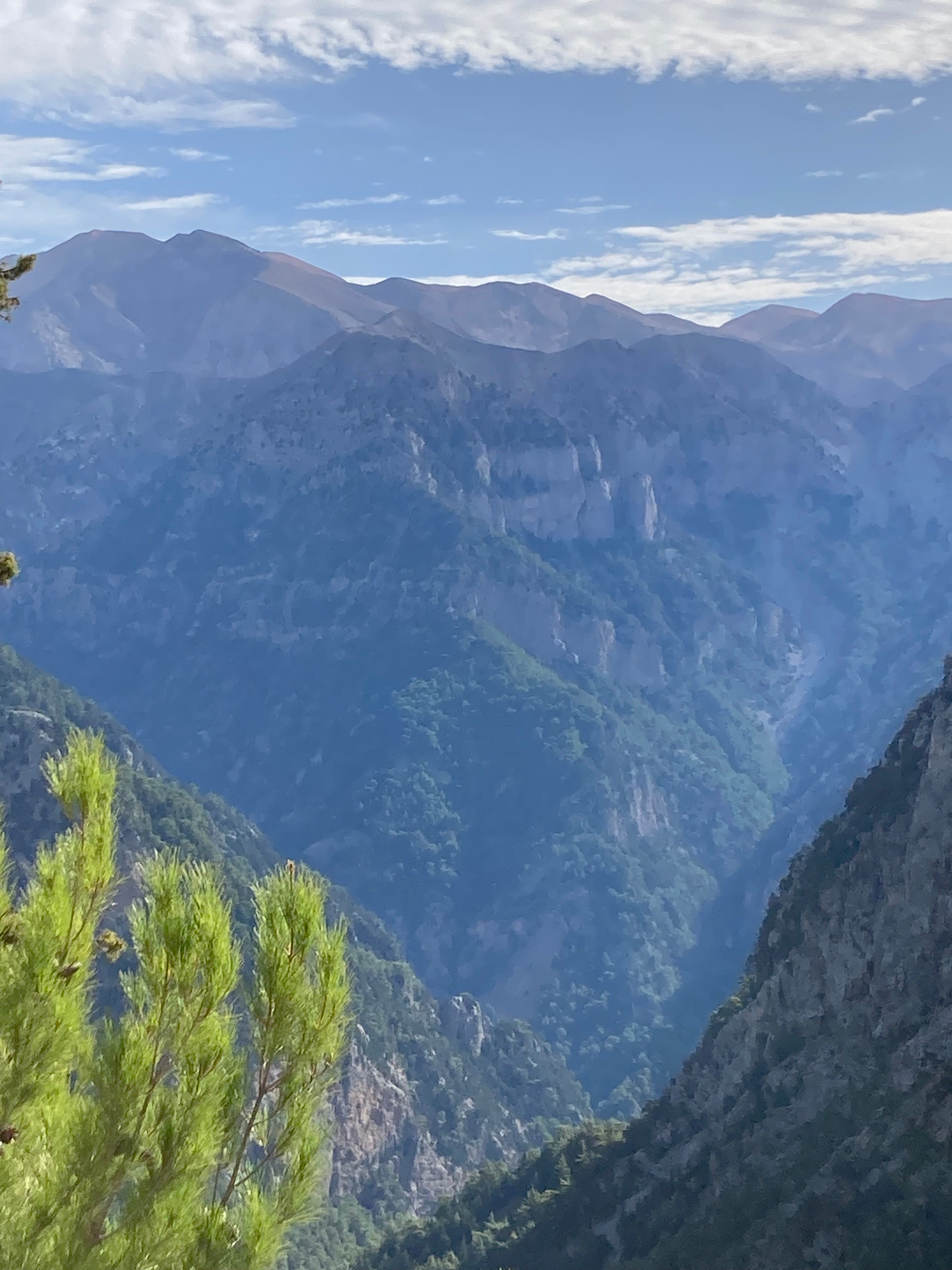
Samaria Gorge, top end
The top of it reached by a somewhat stressful drive along the highway (Cretan drivers do expect you to dip into the hard shoulder for them to overtake, if there’s any sense you might be dawdling), followed by hairpin mountain roads with goats and sheep sitting in the middle of them.
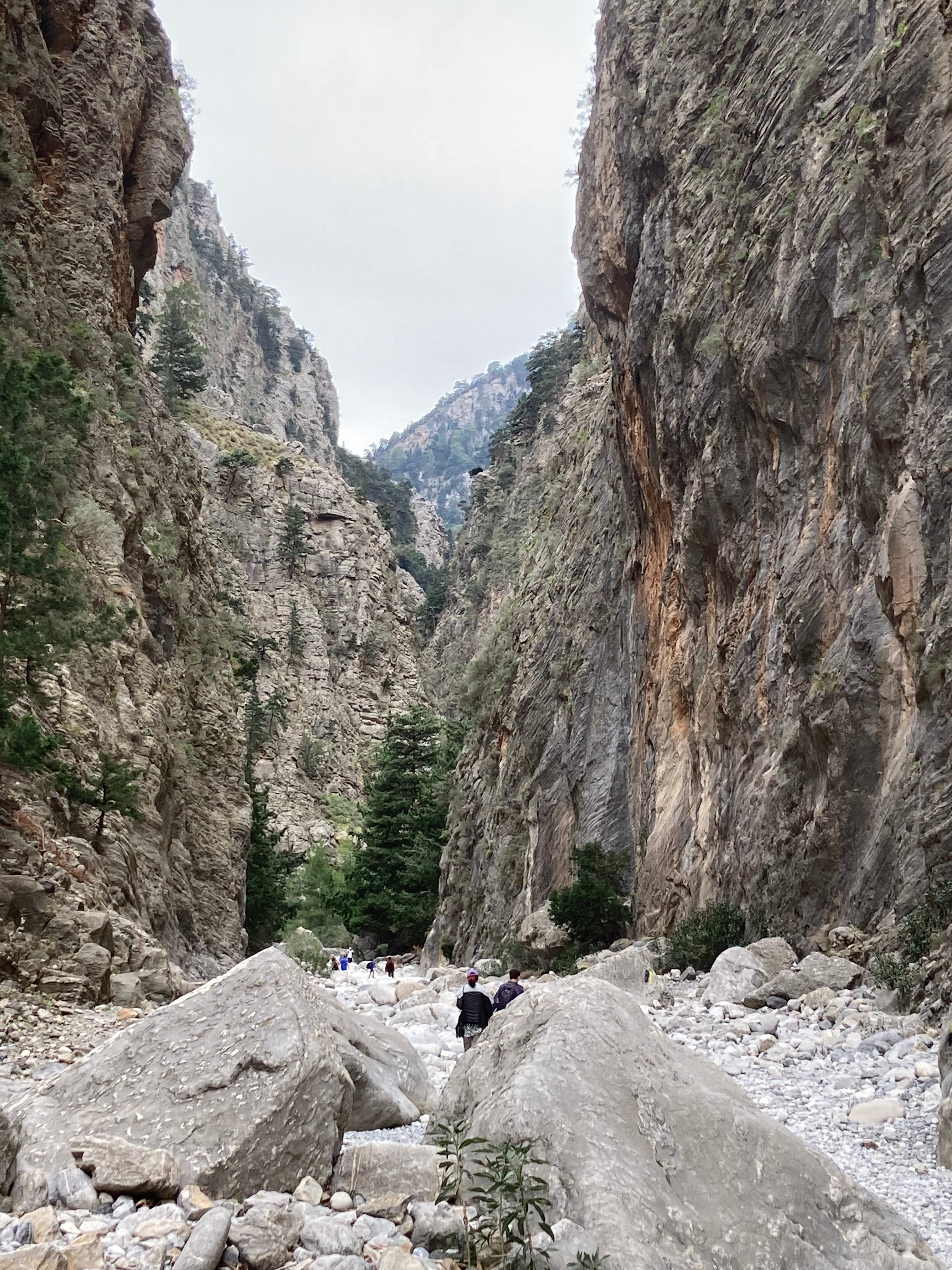
Samaria Gorge, bottom end
But Crete is big in all sort of other senses – the cultural importance belying the apparently out-of-the-way position and isolated culture.
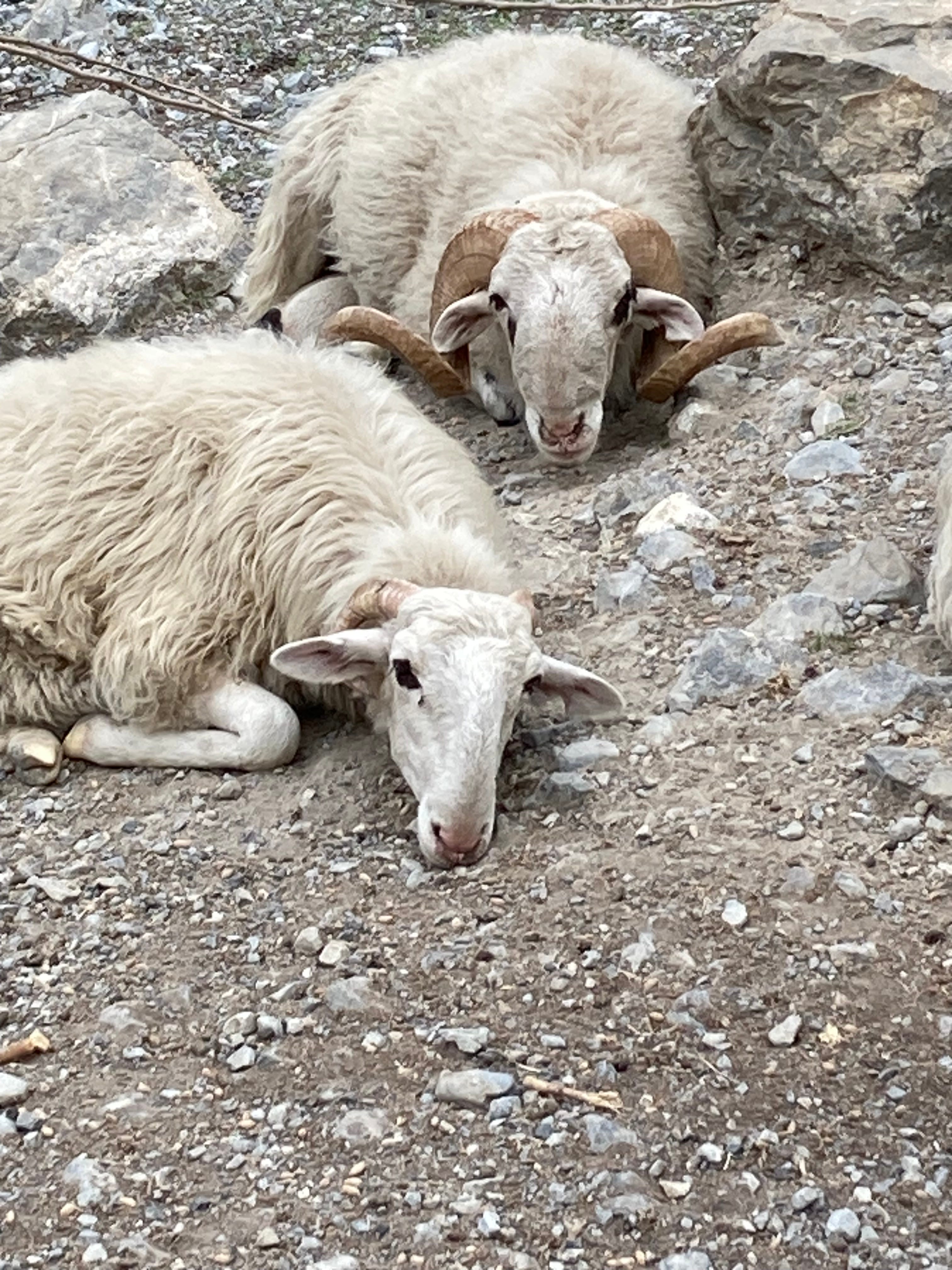
Sheep along the way
It’s most famous as the seat of the oldest known Greek civilization, the Minoan, with its palace at Knossos and a number of other cities boasting archaeological remains. But it’s remarkably prominent in myth too. For it’s here, in a cave under Mount Ida, that Zeus was hidden by his mother to prevent him being eaten by his father Kronos (the classic fatherly response to one of those son-will-overthrow-the-father-if-you-let-him-live prophecies). Mount Ida, too, that was a favoured haunt of the gods and goddesses later, especially as they watched, and from time to time interfered with, the twists and turns of the Trojan War.
To turn to the distinctly dodgier phase of Zeus’ activity, it’s in Crete too – specifically in Gortyn, about 50 km south of Heraklion – that he is supposed to have ravished the Phoenician princess Europa, having carried her off from her home after assuming the form of a bull, or possibly just sending a bull to do this.
I must confess I’m always puzzled by the role of Zeus’ animal transformation in these stories, and its precise relationship to the sexual act. Is he still a bull when that happens? And if so why? But then, why did he need to become a bull in the first place – or even send one? The poet Ovid for example – followed by Titian et al. – draws a veil over the actual event, ending his account with Europa holding onto the bull’s horn as she is wistfully carried off to sea.
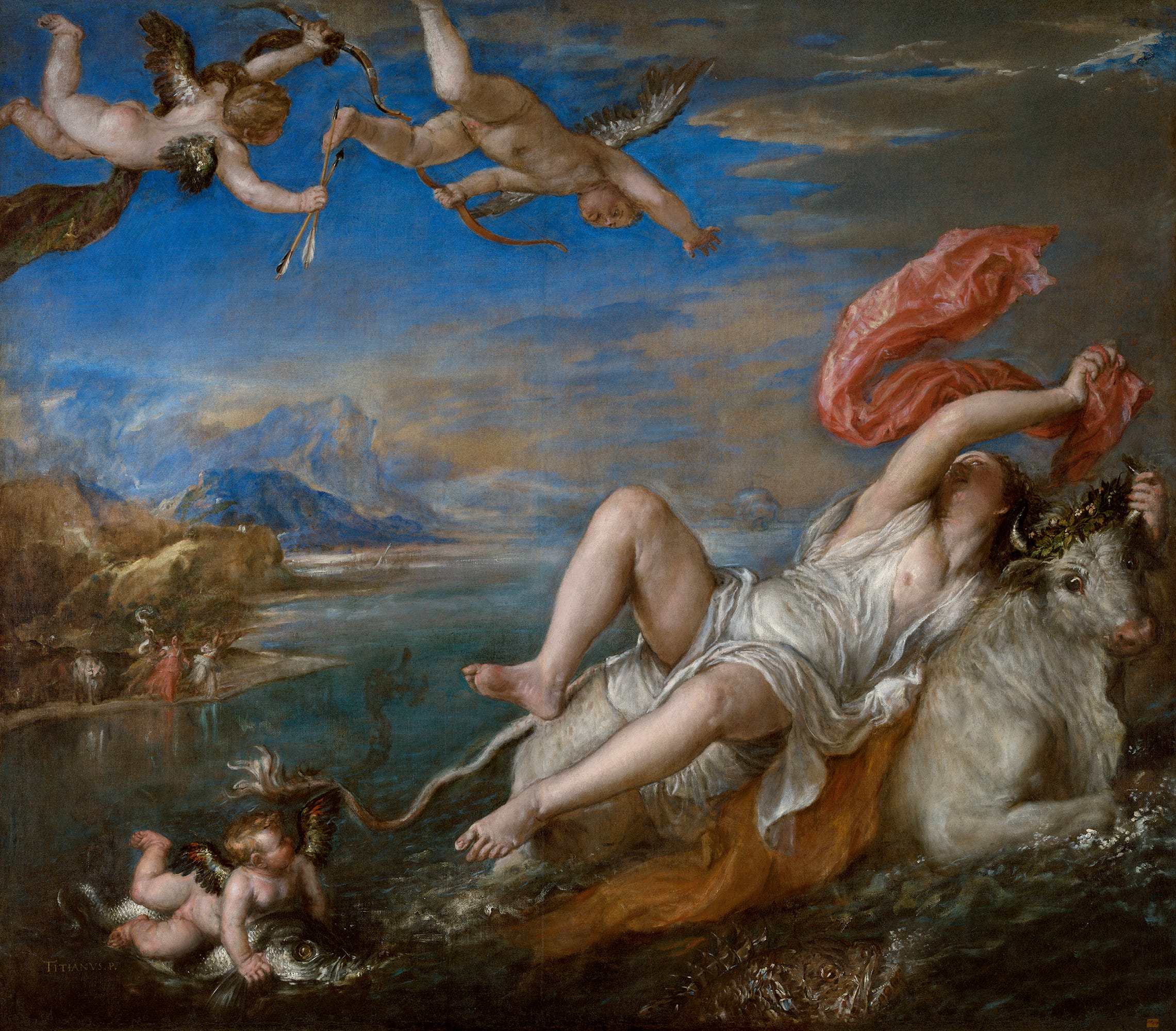
Titian, Rape of Europa, Isabella Stewart Gardner Museum, Boston
Another key example is his seduction of Leda in the form of a swan. Another image much loved by painters, from antiquity through the Renaissance. And in that case his continued swannishness seems clear from the fact that Leda gave birth to eggs as a result of the encounter.
But we digress. Anyway, as guides and guidebooks assure you, you can still see the plane tree under which the legendary coupling took place.
I recommend the visit to Gortyn, not for that reason, but for a chaotic but enjoyable wander through pomegranate, olive and pine groves with bits of stone sticking up amongst them, for a rather fine museum (when at last we found it), and for the Gortyn Law Code, a remarkable collection of stones with inscriptions giving vital evidence (as the philologically minded will remember) for the Cretan dialect of ancient Greek.
The sprawling archaeological site is in fact sufficiently chaotic and poorly signposted that, rather fortuitously, we get lost and find ourselves at a deserted taverna. The proprietor welcomes and expresses her curiosity about us. Perhaps out of boredom, perhaps impressed by our ability to use a little Greek in communication, or perhaps simply from an inveterate sense of hospitality, she insists on cooking up a complimentary sweet for us while we drink our coffee. A halva, consisting of semolina, orange peel, cinnamon, sugar.
Then there is the most famous family of all in Cretan legend, and perhaps one of the most dysfunctional – that of King Minos. Minos himself was one of the products of that under-the-plane-tree dalliance. While the Minotaur that he kept in the Labyrinth was the result of another example of bull-on-human action, involving his wife Pasiphaë and a bull sacred to the god Poseidon.
It’s Minos, of course, that gave his name to the ‘Minoan’ culture of Greece, archaeologists of a certain period being unable to resist the connection between the real stones they uncover and a famous civilization which could be thought to belong to roughly the right period, albeit a mythical one …
The name is not the only slightly fantastical thing about the excavation of Knossos, the chief palace of this ‘Minoan’ culture. We visit it on a cold sunny day, when the site is particularly beautiful in the mid-afternoon light. We wander around the rocks and the huge pithoi, enjoying the views across to the mountains, vaguely trying to make sense of explanations and interpretations of the spaces, We wonder at Arthur Evans’ optimistic and now notorious reconstructions.
For they too – in the soberer eyes of later archaeology – have more than a hint of fantasy about them. It’s all massively out of date, and of course you wouldn’t do it these days.
Still, I confess to a certain sympathy. The original impulse of archaeology comes (doesn’t it?) from a dreamer’s impulse to discover or recreate lost worlds. Through training that naturally gets overlaid with a commitment to sober research and purely evidence-based conclusions … but still, the desire and the need to find more of a story in the stones, something more than they can actually tell you.
A tremendous gaggle of crows swirls up from a tree, making much noise.
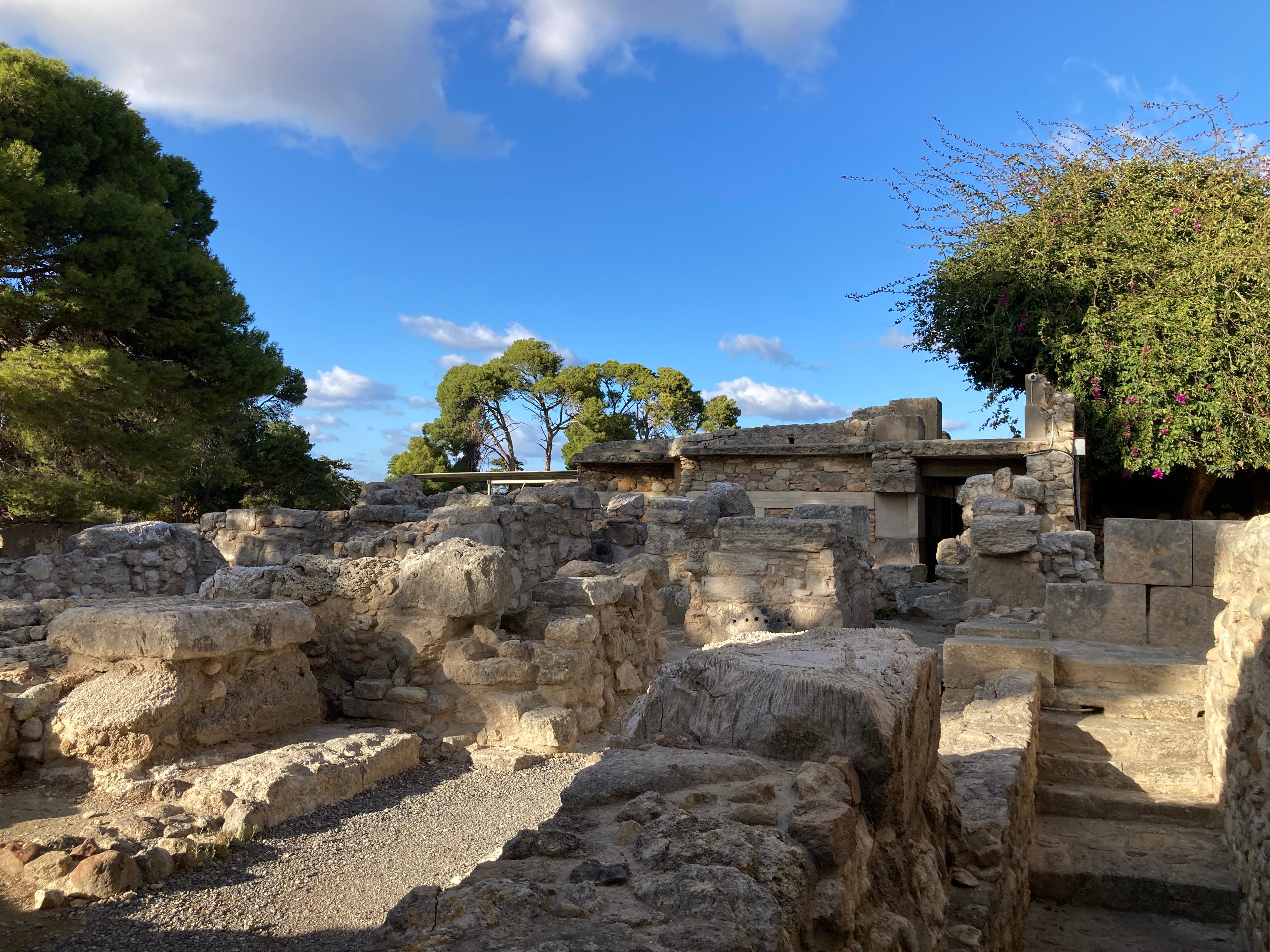
Knossos, the stones amid the trees
BACK TO HISTORY
Moving forward a bit in time, and into realm of history rather than myth, it’s delightful to find that Crete was renowned as a place of gardens and plants, even in ancient times. Delightful not just because people travel to Crete in spring just for the flowers, but also because the tradition of cultivating and foraging valuable herbs survives actively to this day. Apart from the wild greens mentioned already, no one is without their supply of the local herbal teas, bought it huge bunches from the greengrocer – the malotira, díktamo, karteraki … The tradition doubtless goes back into the mists of time; but during the Roman empire Crete was treated as a sort of imperial garden – a major source of botanical herbs for perfumes and materia medica, with a gardener on site employed directly by the emperor.
As Galen writes the second century AD, in one of his works on herbal remedies:
Some products are brought to Rome almost every day, for example … the very large quantity imported from Crete, where they are grown by horticulturalists kept for that purpose by the Emperor. They are imported not just for him but for the city of Rome as a whole … Such items are transported from Crete to many other populations too: none is without the products of that island – the herbs, fruit, seeds, roots and juices. All are pure – the abundance of the plants that grow there means that the growers seldom attempt any fakery.
It was in Roman times, too, that Gortyn – that chaotic site with olive-grown stones, the dubious plane tree and the rather good museum – reached its peak …
CANDIA
But we must go forward a few centuries, to come up to date and to explain the multi-cultural mess that constitutes Crete’s – and in particular Heraklion’s – present-day incarnation. Candia – as it is in the more romantic medieval and early-modern appellation – was founded as their capital by the Arabs, when they took over the island from Byzantine rule in the 820s and destroyed the previous capital, Gortyn. (There had been earlier Greek habitations in Heraklion, but nothing really substantial.) The Arabs named it al-Khandaq meaning ‘of the Moat’; and the moat with impressive accompanying fortification remains a prominent feature.
The island was recaptured for the Byzantines about 140 years later by the general Nicephoros Phocas, who became emperor shortly afterwards. It’s then that things get quite complicated, as the internecine politics of the collapsing Byzantine emperor meet the power struggles of western potentates. An approximate version is as follows. The island was ‘given’ to Boniface I, Marquis of Montferrat, a leader of the Fourth Crusade, in 1203, by Isaac II, who had been deposed as Byzantine emperor (and incidentally blinded), and/or by his son Alexios IV, as part of a deal to gain support for their reinstatement on the throne. (Which did happen … though this second period of rule lasted about six months, the Crusaders ultimately deciding to install their own, western, emperor, Baldwin I.)
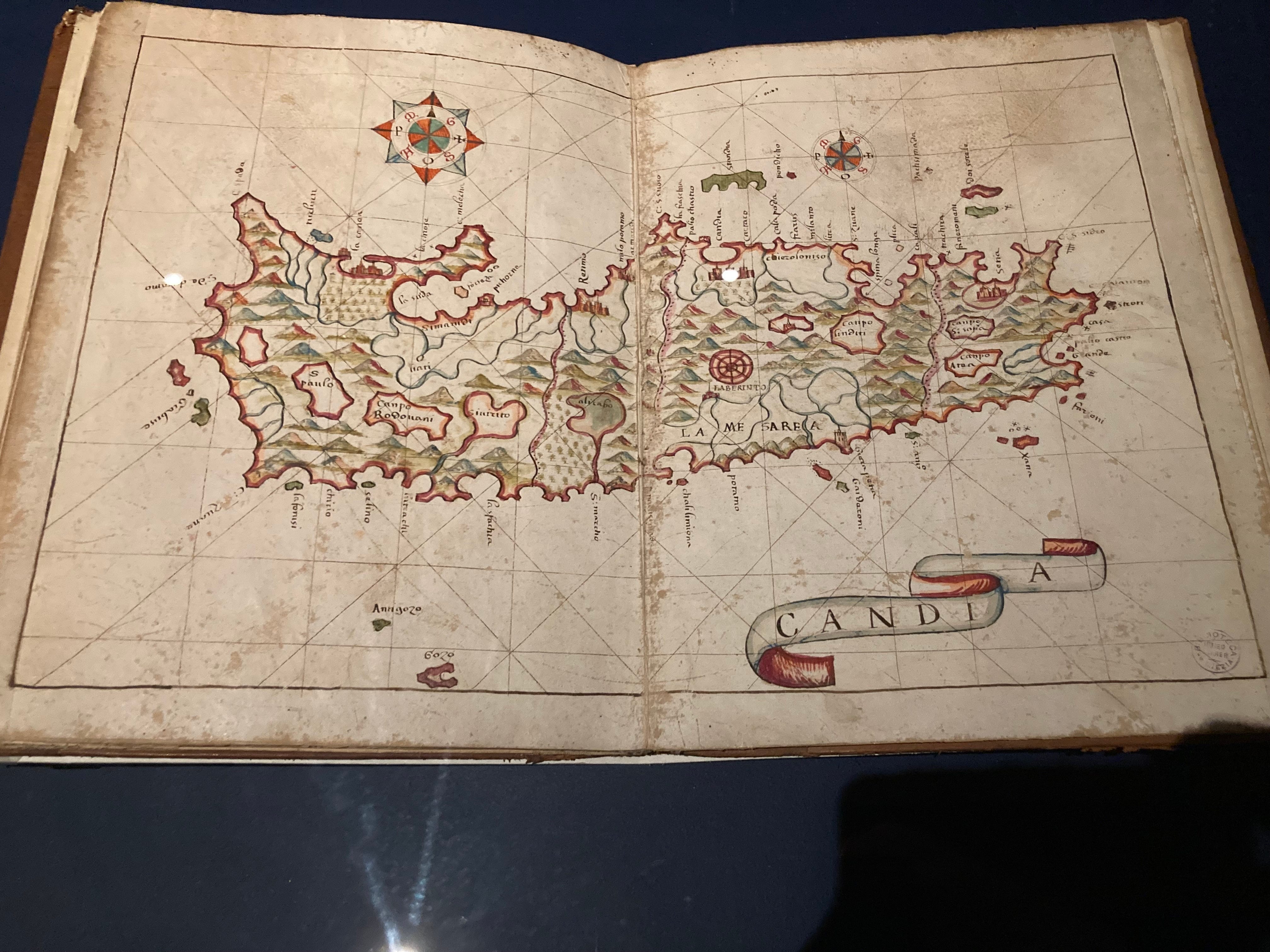
Venetian Map of Candia (the mediaeval name for the whole island as well as for Heraklion)
Meanwhile Boniface ‘sold’ the island on to the Venetians, who then squabbled over it for a few years with their rival maritime power, the Genoese, before consolidating control of it in about 1212. And remaining in power until the seventeenth century, when, after a decades-long siege of Candia, the whole island fell to the Turks. It was the governor Francesco Morosini – he of the lion fountain and the fresh water – that was forced to cede, in 1669.
A final digression from our digression – and probably the thing most remembered about that unfortunate Morosini – is his connection with the acropolis of Athens and the Parthenon marbles. For the battle over Candia was part of a larger conflict between the Ottomans and the Venetians, and some eighteen years later the same Morosini – in spite of having been tried for cowardice and treason on return to Venice – led the siege of the acropolis of Athens, in 1687, as part of the Morean War. It was during this siege that, notoriously, a shell hit the Parthenon, where the Turks were storing ammunition. The massive explosion killed about 300 people as well as largely destroying the structure. Contemporary reports suggest that the targeting of the Parthenon/armoury was deliberate, and even if the fatal shot seems actually to have been fired by a German officer (from the forces of the allied Duchy of Braunschweig), it was in line with Morosini’s tactics and he allegedly described it as a ‘lucky hit’ (‘fortunato colpo’).
ADDIO
Before running for my bus I grab a last fruity pourover coffee, along with an insanely large tahini roll, at Frankly, the hipster café, with the Byzantine church just over my shoulder. The perfect old-new experience.
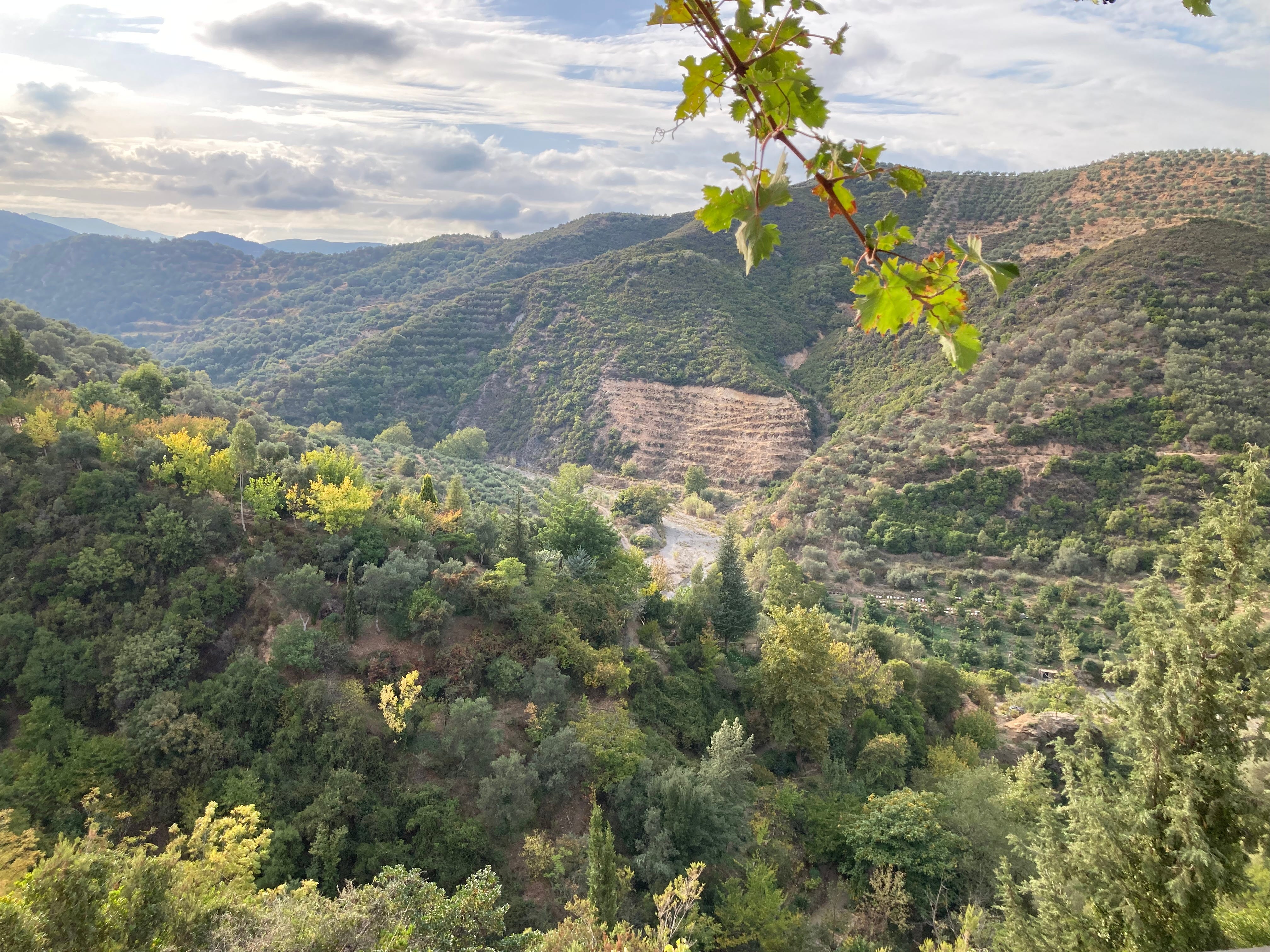
Mountain view from the Botanical Gardens, Crete
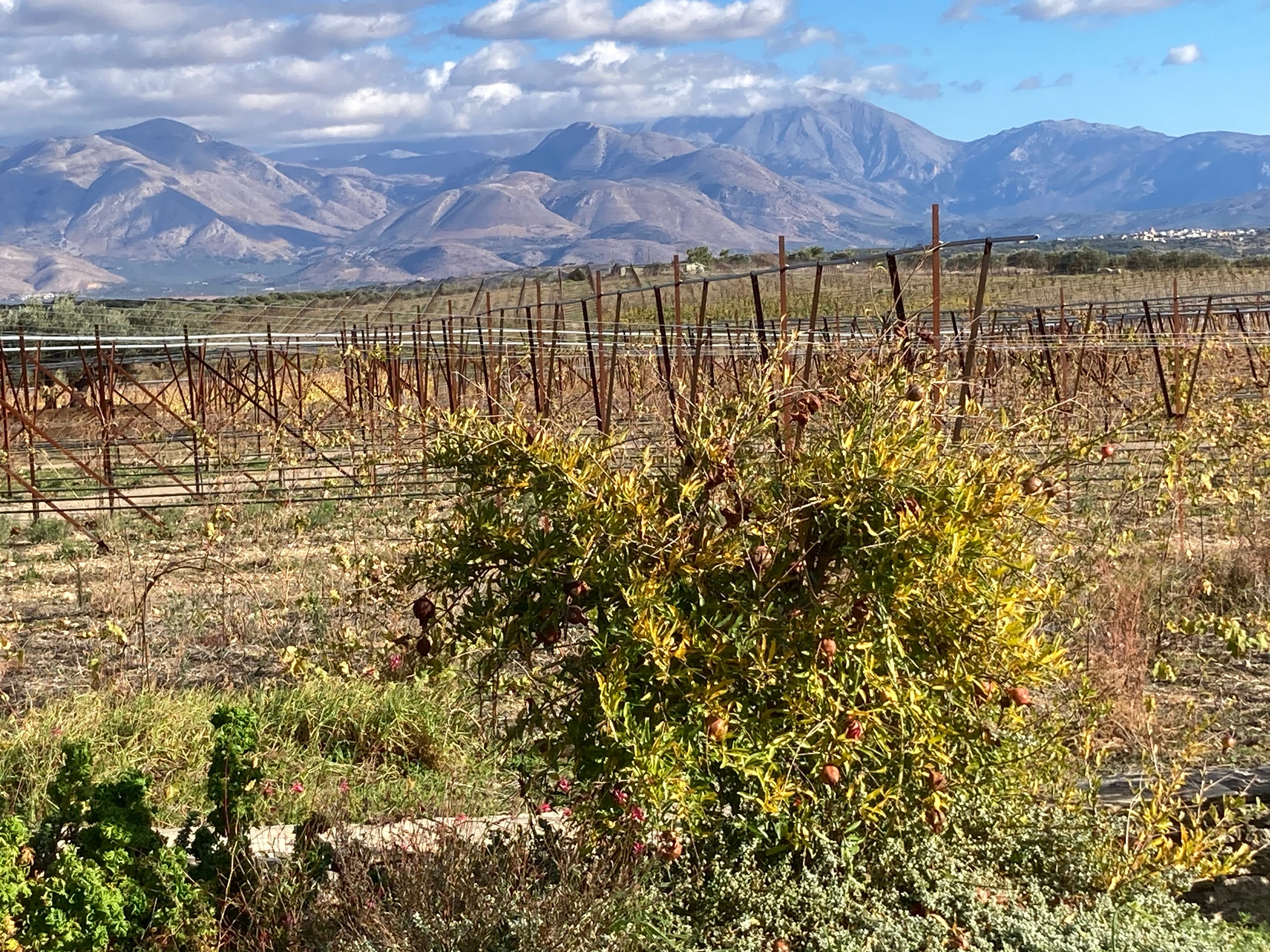
View of mountains over Lyrakakis vineyard, south of Heraklion